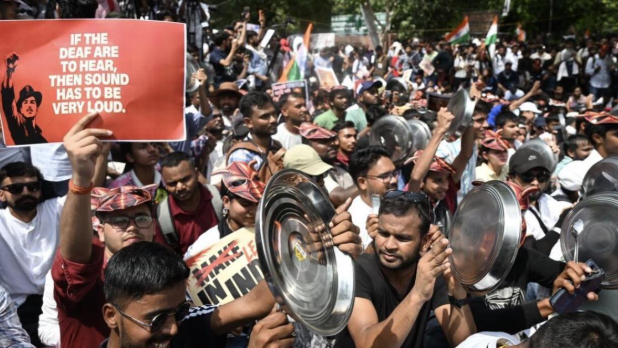
In the wake of the alleged paper leaks in NEET and other competitive examinations, deaths of at least twenty students have been reportedly associated with examination-induced distress. Against this backdrop, protests have been organised by the Cockroach Janta Party (CJP) demanding systematic changes in the education system and the resignation of Dharmendra Pradhan, the Education Minister of India.
Sonam Wangchuk, who is an engineer, educator and an activist from Ladakh, joined the protest on 29 June, and started an indefinite hunger strike to further support the cause of the movement. Alongside him, multiple CJP members also joined the hunger strike, holding out until their demands were met.
The protests that started on 29 June intensified after Sonam Wangchuk was forcibly moved to a hospital on 18 July in hopes to end his hunger strike. On 20 July 2026, India saw a revolutionary youth movement called ‘Chalo Sansad’, a march to the Parliament, led by Abhijeet Dipke, leader of CJP. Thousands of protesters gathered at Jantar Mantar, and took to the streets of New Delhi, infuriated with the government and determined to secure concrete reformation.
Protesters continued to set up tents at the protest site. The tents brimmed with posters, expressing the displeasement of the civilians. The names of those on hunger strike were stuck on boards, along with the number of days that they have been protesting.
After 21 long days, Sonam Wangchuk decided to continue his fast even at the hospital and refused to stop until the students received the justice they deserve, even after exhibiting clinical signs of dehydration and severe health deterioration.
However, as days passed the events at Jantar Mantar spiralled out of the control of the CJP leaders. On July 20, during the ‘Chalo Sansad’ movement, the use of force by Delhi Police against the protesters ended up severely injuring them. Among these were also children and youngsters who arrived at the site with peaceful intentions. This incident spread online quickly, and sparked widespread anger amongst the youth of India. Following this, protests were initiated in different parts of India as the youth stood in solidarity with all those injured at Jantar Mantar.
In Patna, Bihar, hundreds of student demonstrators gathered at Gandhi Maidan and marched toward Dak Bungalow and Bailey Road; as police deployed water cannons and tear gas, leading to viral moments where students danced under the water spray.
In Kolkata, West Bengal the unified student march commenced in the Sealdah Station area and continued till the Esplanade area. Another solidarity rally was witnessed as thousands of citizens, students, and youth groups walked from the Jadavpur 8B area to Golpark.
Mumbai-based activists and citizens gathered at the Azad Maidan, echoing the voice of youth all around India. Mumbai Police registered eight First Information Reports (FIRs) in connection with the protests held across the city with the largest case being registered at Shivaji Park Police Station with over 600 protesters booked.
In Pune, the march began at Shaniwar Wada and concluded at the Collector’s Office, as participants arrived with placards highlighting their demands, deterred by the intermittent rain. They peacefully carried forward their march to the Collector’s Office while the Pune Police showed complete cooperation and handled the event with utmost precision.
Following these events, Sonam Wangchuk on 24 July, during the early hours of the morning, broke his indefinite hunger strike after twenty six long days, in the presence of two Union Ministers only on the condition that the government will take into account the compensation for the NEET aspirant students who lost their lives. He also demanded the cases of students present in the protest be taken back. He successfully got a written agreement for both his demands and finally broke his fast.
This, however, did nothing to help the protests die down. Abhijeet Dipke, along with many CJP members, was still on a hunger strike and the protests carried on in full force until the demands were met. Crowds still gathered at protest sites in respective cities, civilians were still waiting for answers and the youth was still hopeful. In support of those spending nights at Jantar Mantar, Indians from all around the country sent food, water, medicines and other necessities at the site as a symbol of silent support.
Those who could not join the protests, helped spread awareness about the situation on digital platforms. Social media played a significant role in amplifying and spreading awareness about the protest. Social media covered the information on the protest that mainstream media did not broadcast. Students used platforms like Instagram and X to share updates and document events in real time. Celebrities and public figures also shared posts expressing solidarity and helping the movement gain momentum. Renowned personalities like Shabana Azmi, Imran Khan, Swara Bhaskar, Huma Qureshi and Prakash Raj also joined the protest and stood with thousands of students for their cause.
Fortunately, their efforts and struggles did not go unnoticed because on July 25, Dharmendra Pradhan announced his resignation as the Education Minister after serving five years of his term. In his letter, Dharmendra Pradhan mentions that more than his ‘individual prestige’ he was disturbed to see the series of events that took place over the last ten days.
This development prompted the CJP to call off the protests at Jantar Mantar after a prolonged 36 days. President Droupadi Murmu accepted his resignation letter. Later, on the advice of the Prime Minister, she appointed Pralhad Joshi as the new Education Minister of India. Ultimately, the protests transformed public outrage into a coordinated movement for change. While the immediate demands remain contested, they succeeded in significant structural reform in the education system.
Leave a Reply