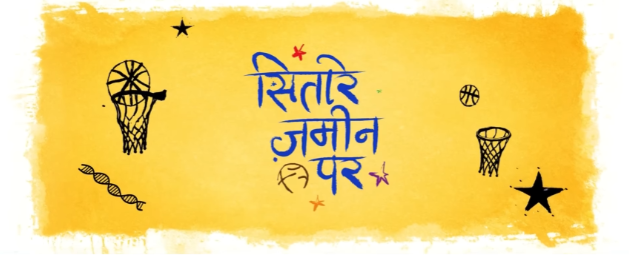
We can all agree that the initial announcement of the Aamir Khan-led sequel to Taare Zameen Par- Sitaare Zameen Par- was met with a divided stance. While it still had the power to spark nostalgia, a doubt lingered: “What if it is not what it once had been?” Upon release, it was established that Sitaare Zameen Par still evoked the raw sense of reality, paralleling its prequel, which redefined how Indian audiences viewed childhood, learning disabilities, and empathy. Sitaare Zameen Par is not just a successor of its prequel, Taare Zameen Par, because it has reimagined the landscape of disabilities again from a whole new perspective altogether. This movie can be lightly described as a “feel-good, sports-centric” story about children with special needs, but it does promise a humorous tone while still carrying the emotional weight Khan’s brand of storytelling is known for.
The arrival of Sitaare Zameen Par occurs in a new narrative space, a more nuanced media landscape where the lines between the TV in our living rooms and the big screen have been blurred. Digital spaces have competed with the cinematic universes to create a new level. And in such a present, we ask, Would Sitaare Zameen Par thrive as an OTT release- or does it demand the pause, the magnificence of storytelling, and the spectacle of a big screen?
The Legacy Effect: Can Emotion Scale Digitally?
Despite not being a direct sequel, Sitaare Zameen Par still packs the same kick. Expectations reach new heights as sensitivity and transformation, and a protagonist who moves the audience, rise as the real heroes of this cinematic journey.
Although this emotional legacy is powerful, it could be a double-edged sword in the OTT space.
An OTT platform is no better than these fast fashion trends that have us in a chokehold every week. Buzzing engagement derived from algorithmic strategies is the powers that push content that is simply summarized in thumbnails, keywords and 30-seconds of someone on a reel saying: “This movie in the theatres-” Here is where we know at the back of our minds that a film like Sitaare Zameen Par, which is likely to build slowly, focusing on character arcs and emotional payoffs, may not fit easily into the scroll-happy ecosystem.
In the theatres, emotional storytelling still holds space. Families show up. Word-of-mouth builds over weekends. Conversations linger. If well-executed, a film like Sitaare Zameen Par can become an event in theatres. On OTT, however, it risks becoming one among hundreds of feel-good titles competing for the same attention span.
Aamir Khan’s Star Power: Still Box Office Gold?
Amir Khan’s magnanimous comeback to the big screen after his project Laal Singh Chaddha’s commercial failure is enough to draw audiences into theatres. This movie only gives in to the anticipation more. Khan’s track record includes era-defining blockbusters like PK, Dangal, and 3 Idiots– all films that blended social relevance with entertainment.
But can Aamir’s brand of cinema still command the box office in a post-pandemic world?
Streaming has changed consumption habits. Viewers now wait for digital releases instead of heading to theatres for anything outside the action or franchise space. Even major stars have opted for OTT debuts or simultaneous releases.
However, Aamir’s storytelling has always relied on shared emotion, and that translates best in theatres. Sitaare Zameen Par delivers a mix of inspiration and sentiment, and a theatrical release is enough to restore the lost glamour of family cinema.
Was Khan’s reluctance to release Sitare Zameen Par on OTT the driving force of its success?
That said, the advantages of an OTT release aren’t negligible, especially for a niche topic.
Amir Khan’s consistent decision to delay the OTT release of Sitare Zameen Par cannot be just regarded as a choice of distribution; it was a calculated risk that flourished into success. Digital premieres hold immense power when it comes to catching the attention of an algorithmic audience, and that is 90% of the movie fanatics. Khan insisted over and over again that a theatrical release would be appropriate for this movie, and in the process made us realise that we have not completely become a victim of the labyrinth that is the internet. This created scarcity, causing an uproar of amplified anticipation, drawing audiences back to theatres for the collective experience they had long missed. But it wasn’t that Sitare Zameen Par’s absence was the only driving force behind its box office success; this movie was an overloaded pack of heartfelt storytelling and strong performances, once again making us believe in Khan’s creative vision. His strategic stand against immediate digital access underscored the film’s emotional gravity, positioning it not just as entertainment, but as an event—something to be felt, not just streamed.
A Theatrical Gamble Worth Taking?
Finally, Sitaare Zameen Par is a movie that deserves the space it has created after its theatrical drop. It deserves the attention and cult following of its prequel. Centred around children who often don’t have a voice, told by an actor-director who consistently chooses meaningful storytelling over formulaic payoff, is a revolution mobilising with every new film.
That’s something OTT still struggles to replicate: the multi-generational viewing experience that feels both communal and transformative.
Sitaare Zameen Par is a reminder that soft cinema still matters in a market obsessed with spectacle. Standing much apart from the emotional rollercoaster of Taare Zameen Par, this sequel is a cheerful digression. A movie that carries a message as strong as this duology undoubtedly has the potential to become more of a force to be reckoned with on big screens than on smaller tablet ones.
The theatres may be fewer. Audience tastes may be shifting. But some stories still deserve to be watched with your phone off, your heart open, and your seat grounded in a room full of strangers, feeling the same thing simultaneously.
And if anyone can make that work in 2025, it’s Aamir Khan.
Leave a Reply