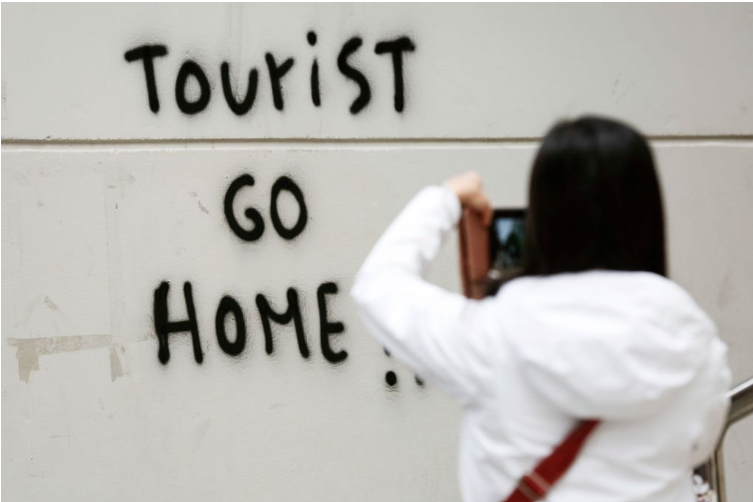
Across Europe this summer, locals have taken to the streets with a clear message: mass tourism is pushing them out of their cities. Residents are retaliating against rising rents, overrun public spaces, and a lifestyle that’s being sold for profit.
Anti-tourism protests have occurred all summer across various European countries, including Spain, the Netherlands, and Italy. Thousands of protesters have taken to the city’s streets over the past few months to protest against mass tourism in Spain, especially in San Sebastián, which has the nation’s highest housing costs. There, protesters chanted slogans, one being, “Sustainable tourism is a mythological animal.”
In June, Genoa residents staged a symbolic “noisy stroll” protest, dragging suitcases through the city centre to highlight the disruptive impact of mass tourism.
Most recently, thousands of people protested on the Spanish island of Mallorca, with organisers arguing that the current tourism model exploits workers while benefiting only a small elite. Similar demonstrations have also taken place on other popular Spanish resort islands, such as Minorca and Ibiza. These islands, with a population of just over one million, hosted more than 15 million international tourists in 2024.
On June 15, locals in Barcelona started spraying tourists with water and chanting, “tourists go back home.” Others also carried signs with slogans such as “Barcelona is not for sale” and “Tourism is stealing from us.”
The ongoing demonstrations intend to shed light on the blatant “touristification” of European cities. The term refers to the emphasis and priority given to tourism rather than sustaining local life, amenities, and infrastructure. The protests aim to pressure governments to address the strain tourism has on rents and housing, and the collateral environmental damage caused. Many call for policy and urban planning that puts residents’ needs and livelihoods ahead of tourist demand. In cities like Venice, where fewer than 50,000 people live year-round, over 30 million tourists visit annually. As a result, much of the hospitality industry caters to the visitors rather than residents.

A protester holds a sign reading “Tourism is killing Barcelona” during an anti-tourism demonstration in the city. / Photo: X / @UinHurricane
Mass tourism has disrupted daily life across Europe, and one of the most pressing issues locals face is housing. Residential units have been scarce and are slowly being converted to tourist accommodations. This scarcity has also led to a significant hike in rent and housing prices. Reports conducted by Harvard International Review have indicated that there are now more tourist beds than residents in Venice. During protests in San Sebastián, a resort city on Spain’s northern coast, some residents stated that their leading cause of concern isn’t the act of tourism itself, but rather the “speculators and exploiters who use tourism as a facade to ultimately profit from the housing and overall lives of the residents.” Locals have also started advocating for more sustainable practices to protect natural resources, local infrastructure, and heritage sites. In 2023, a tourist was accused of damaging a statue in the city’s 16th-century Fountain of Neptune, located in the Piazza della Signoria. The same year, in another part of Italy, a group of tourists was accused of toppling a valuable statue at a villa.
During the 2024 Olympics in Paris, a city with only 11.3 million residents, approximately 9.5 million individuals purchased tickets to attend the Games. In protest against the pollution of the Seine, which was expected to worsen with Olympic preparations, locals threatened to stage a mass defecation in the river, rallying under the hashtag #JeChieDansLaSeineLe23Juin (“I sh*t in the Seine on June 23”). The campaign, widely reported by outlets including CBS News and Forbes, was dubbed the “Paris Poop Protest” by Modern Diplomacy, which described how activists used a dedicated website and hashtag to coordinate their demonstration against both river pollution and government spending.
Governments have gradually started responding to these persisting protests; cities like Barcelona have begun cracking down on illegal rentals and changing specific bus routes to protect elderly residents. Places like Santorini in Greece and Bruges in Belgium have started imposing taxes on their tourism and hospitality industries. Venetian officials recently declared the temporary entrance fee, implemented to control tourist crowds, a success. The new €5 (about $5.4) tourist charge, which began on April 25 and concluded on July 14, brought in more than €2.4 million (about $2.6 million).
The summer of protest across Europe has made one thing clear: locals are no longer willing to stay silent as their cities transform into playgrounds for outsiders. While tourism remains a crucial economic engine, the cost of unchecked visitor influx, rising rents, environmental strain, and local life erosion has become too heavy to bear. As more residents push back, governments must reckon with a future in which tourism must be reimagined. Whether these measures can truly shift global travel culture remains to be seen.
Leave a Reply