Blog

  • After Nearly a Century, HUL Gets Its First Female Chief

    After Nearly a Century, HUL Gets Its First Female Chief

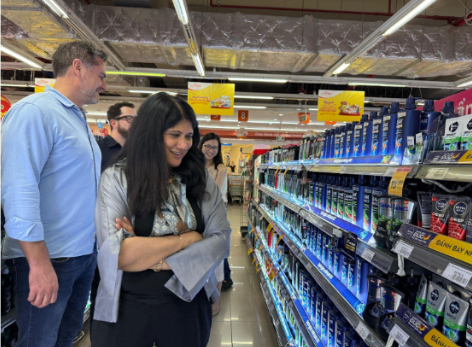
    For the first time in its 92-year history, Hindustan Unilever Limited (HUL) will be led by a woman. Priya Nair has been appointed as the new CEO and Managing Director of HUL, and will be taking over from Rohit Jawa on August 1st, 2025.

    Priya Nair isn’t new to HUL. She has worked for the company for almost 30 years, starting in sales and marketing and steadily climbing the ladder, proving herself every step of the way. She is currently the President of the beauty and wellbeing sector at Unilever, where she led iconic campaigns for brands like Dove, Rin and Comfort. She is also known for creating stories that connect with people, especially women and families, and her in-depth understanding of the Indian market made her one of the most respected marketers in the industry.

    But this move is more than just a change in the job title. It highlights the slow pace of change in the Indian boardrooms. HUL, a household name with products in nearly every Indian home, had never had a female CEO for almost a century, and Nair’s appointment is a clear sign that leadership is finally becoming more inclusive.

    She brings to the table not just experience, but also empathy. Her leadership style is expected to focus on people, sustainability, and innovation. As consumer habits change, especially post-pandemic, HUL will need fresh ideas to stay relevant. Her track record shows she understands this shift. She led campaigns that didn’t just sell soap or shampoo; they told stories that made people feel seen and heard.

    Her promotion also sends a message to young women across the country – the top seat is within reach. Even in industries where men have always held power, things are changing. It’s a reminder that talent, vision, and consistency can break barriers,  even those built over nine decades.

    HUL is India’s biggest fast-moving consumer goods (FMCG) company. It sells everything from tea and detergent to skincare and health products. With over 50 brands in its portfolio and a presence in every part of the country, leading HUL is no small task. But Nair is seen as someone ready for the challenge.

  • Elon Musk Launches America Party: Fiscal Conservatism, Electric Cars, Revenge

    Elon Musk Launches America Party: Fiscal Conservatism, Electric Cars, Revenge

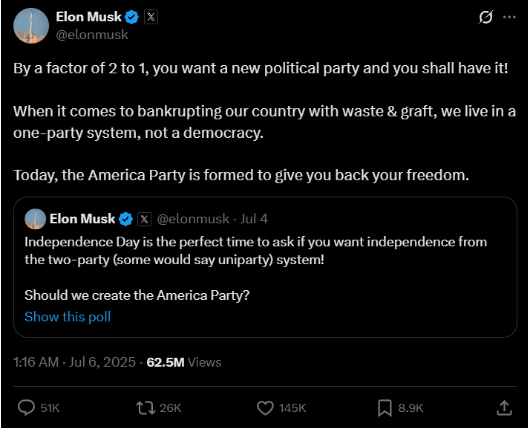
    Billionaire Elon Musk, on Saturday, announced the launch of a new ‘centrist’ political party, the ‘America Party,’ which looks like both a political gamble and an escalation to his very public feud with US President Donald Trump. In a series of posts on his platform X, Musk has positioned the new party as a direct challenge to America’s historic two-party system.

    “By a factor of 2 to 1, you want a new political party, and you shall have it!” Musk posted, citing a poll he ran on X. He added, “When it comes to bankrupting our country with waste and graft, we live in a one-party system, not a democracy. Today, the America Party is formed to give you back your freedom.”

    However, there is no evidence as of now of Musk formally registering the party with the Federal Election Commission (FEC). Musk, who was born in South Africa and is ineligible to run for president, has not named a leader for the party yet.

    The announcement comes against the backdrop of a dramatic public split with Trump, whom Musk had previously supported with over $275 million in campaign donations. Musk has even served in Trump’s administration as the head of the so-called Department of Government Efficiency (Doge), where he oversaw aggressive cuts to federal programs.

    Their falling out began after Musk publicly criticised Trump’s massive tax and spending bill, which the latter refers to as ‘one big beautiful bill’, which was signed into law last week and is expected to add over $3 trillion to the national deficit. Musk, a prominent leader in the EV industry, has very publicly made his opinions known on the bill, which omitted subsidies for electric vehicles, a key interest for Tesla.

    Trump has since then publicly dismissed Musk’s new party as ‘ridiculous’, calling Musk a “TRAIN WRECK” that has gone “off the rails.” Trump has also threatened to revisit federal contracts with Musk’s companies, including SpaceX and Starlink, both of which rely heavily on government deals. He further hinted at potential moves to strip Musk of subsidies or even reconsider his immigration status, despite Musk having been a US citizen since 2002.

    Unbothered by the president’s remarks, Musk suggested that the America Party could start by focusing on a handful of highly contested House and Senate races in the 2026 midterms. He argued that winning just a few seats could give the party leverage in a closely divided Congress.

    Meanwhile, a Reuters report has pointed to a slide of nearly 8% in Tesla’s shares on Monday, following Musk’s announcement. The company is now tasked with selling more than one million vehicles in the second half of the year to avoid a year-on-year decline in sales. If the stock slide continues, Tesla will lose over $80 billion in market value. Can Tesla afford this political venture, given how Trump’s initial threats to cut off subsidies to Musk’s businesses led to a $150 billion wipeout in Tesla’s market cap in a single trading session?

    Despite Musk’s confidence, US political history has shown little success for third parties. So far, the America Party looks more like a personal vendetta than a serious political movement. There are no declared candidates and no clear policies beyond Musk’s usual focus on cutting government spending. No known lawmakers have shown any interest in defecting to his fledgling party.

    In reality, there’s little evidence of a strong voter bloc eager to rally behind Musk. His millions of followers on X and strong financial resources don’t necessarily translate into political power. Without a coalition of committed candidates and grassroots supporters, the America Party risks becoming just another news headline, fizzling out entirely once Musk’s attention shifts elsewhere.

  • HYBE CEO Steps Down Amid BTS Comeback and India Expansion

    HYBE CEO Steps Down Amid BTS Comeback and India Expansion

    Scooter Braun Steps Down: HYBE’s Bold New Era Begins

    In a surprising move, Scooter Braun has stepped down as CEO of HYBE America. Braun, known for managing global stars like Justin Bieber and Ariana Grande, had joined HYBE in 2021 when the South Korean entertainment giant acquired his company Ithaca Holdings for around $1 billion. For years, he played a key role in helping HYBE expand into the American market, leading big-name signings and industry takeovers, including the $300 million acquisition of Quality Control Music. However, as of 1 July 2025, his leadership era has officially ended.

    The timing feels far from random. HYBE insists this transition was planned since the 2021 deal. Braun isn’t completely stepping down though; he will continue as a board member and strategic advisor to HYBE founder Bang Si-hyuk. Isaac Lee, previously heading HYBE’s Latin American operations, has stepped in as the new CEO of HYBE America.

    Braun’s exit has been met with mixed reactions. While his industry connections helped HYBE grow globally, he’s also been a controversial figure, especially after his public feud with Taylor Swift over the ownership of her early music. Many BTS fans, who had long been uneasy about Braun’s influence on HYBE, saw his exit as a “cleansing moment.” In fact, Braun stepping down just hours after BTS reunited online has sparked speculation that this was a calculated reset.

    BTS Is Back: The Comeback Fans Were Dying For

    On the same day, Braun stepped aside, and BTS came together for a surprise livestream on Weverse. All seven members appeared together on screen for the first time in nearly two years, sending ARMYs worldwide into meltdown. The band is officially back from their military service, and they’re already planning their comeback album and tour.

    During the livestream, BTS confirmed that they’ll start working on new music in July 2025 and aim to release a full album by spring 2026. This would be their first full-length group album since “Proof” in 2022. Even more exciting is a world tour planned for the same year. With their military duties now complete, all seven members- Jin, RM, SUGA, j-hope, Jimin, V, and Jungkook- are finally coming back together.

    This comeback means more than just new songs- it marks the return of the most powerful K-pop band of all time. And BTS isn’t just a band; they’re a cultural force. They’ve spoken at the United Nations, topped global charts, and built an army of fans stretching across continents. Their return instantly shifts the entire music industry. It also gives HYBE a significant advantage as it prepares for its next phase of global expansion.

    HYBE Heads to India: A New Chapter Begins 

    HYBE is officially entering India. With its massive population, youthful demographic, and growing love for Korean entertainment, India is a dream market for any entertainment company. HYBE recognised this potential and announced plans to open a full-fledged Indian subsidiary in the second half of 2025.

    The new office is expected to launch around September or October and will likely be based in Mumbai. Preparations have already begun, with research teams surveying the local music market. The company sees India as a core market for developing new artists and bringing K-pop closer to South Asian fans.

    Instead of pushing Korean acts globally, they want to build locally relevant entertainment hubs in major regions like the U.S., Japan, Latin America, and India. It’s not just about bringing BTS and SEVENTEEN to new countries, but about creating Indian stars through the same system that made K-pop what it is today.

    What This Means for Fans 

    For Indian fans, this is a huge deal. HYB’s presence in India allows concerts, exclusive events, official auditions, and local artist development. There’s already a buzz around HYBE’s ‘Cine-Fest’, which will screen BTS and other K-pop concert films in Indian theatres from 10 July to 13 July 2025. This could be regarded as the company testing the waters before launching larger fan engagement events.

    And, of course, all eyes are on whether BTS will finally have concerts in India in 2026. The idea doesn’t seem far-fetched anymore. During his solo promotions, j-hope hinted that India might be added to future tour maps, especially once HYBE formally sets up its office in the country. For millions of Indian ARMYs, that’s a dream come true.

  • Diogo Jota, Portugal and Liverpool Footballer, dies in road accident

    Diogo Jota, Portugal and Liverpool Footballer, dies in road accident

    Diogo Jota, Portuguese footballer for Liverpool FC, died in a road accident on 3rd July, 2025, at the age of 28. His younger brother Andre Silva, travelling with him, was also killed in the accident.

    Just 11 days after his wedding, Jota was returning to England for pre-season. Having recently undergone lung surgery, he was advised to avoid air travel, so he planned to go from Spain to England via ferry. On their way to the port, while trying to overtake another car they suffered a tyre blowout, veering off the road before fatally catching fire. The crash occurred at around 00:30 CEST.

    Tributes poured in worldwide after the deaths were officially confirmed. Many of Jota’s Liverpool and Portugal teammates expressed shock over the news, reminiscing about their shared memories and recent success for club and country. Arne Slot, Liverpool head coach, remarked, “For us as a club, the sense of shock is absolute. Diogo was not just our player. He was a loved one to all of us.” Liverpool announced that they would pay his family the remaining amount of his contract, which ran until 2027. In their reunion performance on 4th July, British band Oasis paid tribute to Jota, with his picture appearing on screen when they performed ‘Live Forever’.

    Born on 4th December 1996 in Porto, Portugal, Jota started his professional football journey with Paços de Ferreira in 2013, becoming the youngest player to score for the club in the Primeira Liga. After playing for various teams like FC Porto and Wolverhampton Wanderers, he was signed by Liverpool FC in 2020. At Liverpool, he helped the team win the cup double in 2022, clinching both the FA Cup and the EFL Cup, as well as winning the league in the 2024-25 season. He was also part of the squad that reached the UEFA Champions League Final in 2022, losing out to Real Madrid 1-0. For Portugal, Jota made his international debut in 2019, contributing to them winning the UEFA Nations League twice, in 2019 and 2025. The 2025 win over Spain was his final match as a football player. He also made appearances for Portugal at the 2021 and 2024 European Championships. Overall, he earned 49 caps for Portugal.

    He is survived by his wife Rute Cardoso, their three children and the millions of fans whose hearts he touched.

  • The Indian Imprint: Craft, Culture, and Controversy on the Runway

    The Indian Imprint: Craft, Culture, and Controversy on the Runway

    In the dazzling world of global luxury fashion, titans such as Louis Vuitton and Prada have turned to Indian culture for inspiration. India, with its unique and rich heritage and craftsmanship, has effortlessly made its mark on the fashion industry. Beyond mere commerce, India’s exquisite textiles, handcrafted jewellery, and intricate embroideries have long attracted designers, leading the country’s diverse fashion to reach international heights, often reimagined through a contemporary lens.

    For example, the recent rave on TikTok about the Indian ‘Jhola’ bags being sold at a whopping budget of Rs. 4100, an item commonly acquired at less than Rs. 100 in India has left minds boggled. The item features Hindi texts and is designated as a ‘chic’ item for enthusiasts of Indian culture. It seems almost unbelievable!

    Furthermore, the Prada-Milan Fashion Week, a global platform for couture novelty, found itself in a controversy between worldwide fashion and cultural heritage and appropriation. Although the conflict started as harmless, the uproar of the Prada shoes, from the indictments of design theft to the vehement demands for cultural attribution, completely caught the fashion house off guard. These handcrafted leather slippers, commonly called Kolhapuris, boast a 900-year history rooted in the states of Maharashtra and Karnataka (India), and were upgraded using high-class leather and metallic bases, proving how simple, authentic Indian crafts can be elevated to a global trend level. Although Prada stated, “We acknowledge the sandals are inspired by traditional Indian handcrafted footwear, with a centuries-old heritage,” the situation ignited a wave of widespread controversy.

    As photos from the runway started to circulate online, outrage in India escalated. Criticising Prada for describing the footwear blandly as “leather flat sandals “ without giving any proper recognition of its origins, and accusing Prada of cultural appropriation. Business tycoon Harsh Goenka reflected the public outcry by stating, “ Indian artisans lose, while global brands cash in on our culture .” With prices reaching $800 abroad, while in India they are sold for as little as Rs. 1000, making the global markup all the more jarring. In response to the growing backlash and controversy, Prada’s head of Corporate Social Responsibility, Lorenzo Bertelli, responded by acknowledging the sandals’ Indian inspiration and expressed willingness to open a dialogue with local artisans for a more meaningful and respectful exchange.

    Interestingly, some believe that this controversy can have an unexpected upside. It has also transpired that the same could yield magnificent results. It is an undeniable element that the sale of sandals in India has shown an immense hike lately. By the perception of the regional designers, such exposure could increase interest in the everlasting styles, particularly among younger clientele.

    “Until now, it hadn’t been considered part of the ‘cool’ or aspirational footwear space in India’s luxury market… I truly believe in the ripple effect of what Prada has done,” expressed Shirin Mann, the founder of Needle Dust, popularly known for its coeval view on classical Indian embroidery slip-ons. Supporting her claim, Google Trends has also shown a noticeable spike in searches for Kolhapuri sandals since the show, while local retailers have reported increased curiosity, especially among younger shoppers.

    Alternatively, Louis Vuitton’s menswear collection, under the direction of Pharrell Williams, offered an enthralling example of such a controversy. Williams’ spring-summer 2026 collection vibrantly showcased India’s uplevelling artistry. The collection features a collaboration with studio Mumbai, altering the fashion runway into a life-sized ‘Snakes & Ladders’. The show included signature Indian colours, accompanied by Bhangra songs. It also showcased an Autorickshaw handbag, a common mode of transport that is a pivotal element of India’s vibrant street life. Adding to the authenticity, the show featured one of the most iconic Indian composers, A.R. Rahman, who co-composed the Punjabi track “Yaara Punjabi.” The track’s cultural depth elevated the entire experience, turning the runway immersive and rooted in Indian identity.

    India’s influence on Western fashion is in no way a new trend. It has influenced the Western world for centuries. From Yves Saint Laurent’s iconic perfume “Opium” subtly echoing Mughal Motifs and rich silks to Dior’s theatrical collections highly resembling Indian grandeur, the list never ends. As the lines between humble Indian handicrafts and contemporary designs continue to blur, one fact becomes significantly clear: India’s eclectic and deeply rooted culture continues to cast an undeniable influence on the outside world, powerfully shaping the very trajectory of upcoming fashion trends.

  • A Costly Consensus: NATO’s 5% Defence Pledge and the Trump Effect

    A Costly Consensus: NATO’s 5% Defence Pledge and the Trump Effect

    In the 2025 North Atlantic Treaty Organisation (NATO) Summit held from 24 June to 26 June, a strong commitment was made by all the NATO countries. The member states have finally agreed to ramp up their defence spending goal to 5% of their gross domestic product (GDP) by 2035, a major jump from the previous target of 2% set in 2014.

    The US president has raised questions about NATO’s collective defence strategies for several months now, narrowly referring to Article 5 of NATO’s Alliance in his defense, which states, “An armed attack against one or more of the allies shall be considered an attack against them all. Trump has avoided explicitly endorsing the clause, claiming there are “multiple definitions of Article 5,” a move seen by many as an effort to avoid confrontation with Russia.

    In response, NATO has worked towards a compromise, agreeing to increase defence spending to keep the U.S. engaged in the alliance. The 32 countries have decided to dedicate 3.5% of their GDP to crucial military needs and 1.5% to other elements such as cybersecurity, infrastructure, etc.

    NATO has publicly stated that the alliance must work towards deterring Russia’s military force. “NATO needs a “quantum leap” in defence to deter threats to the alliance”, Rutte mentioned in a speech given in London, earlier this month. Thus, he urged member states to invest more funds towards defence.

    Trump went on Truth Social to share a message sent to him by NATO Secretary-General, Mark Rutte. In the message, Rutte acknowledged that Trump has driven NATO towards a very important global decision. He also added that Trump has “achieved something NO American president in decades could get done.”

    A New York Times report highlights that Trump has previously bashed NATO for not allocating adequate funds for defence, particularly in the face of threats like Russia. During his first term, Trump had threatened that the USA would exit the NATO alliance. Experts believe that Trump may be undermining NATO from within and that this dramatic agreement was primarily made to ensure that the USA remains an enthusiastic participant in NATO.

    Image Source: WhiteHouse/ @x.com 

    However, not all 32 countries were satisfied with this decision. Spain’s Prime Minister, Pedro Sanchez, had sent a letter to Mr. Rutte saying that Spain “cannot commit to a specific spending target in terms of GDP.” Sanchez insisted that Madrid would need only 2.1% percent of GDP to acquire and maintain all the personnel, equipment, and infrastructures requested by the alliance to confront these threats with their capabilities.

    As a result, every member state will not be forced to reach the 5% threshold; however, there are some standard military requirements that every country is required to meet. Trump vowed that he would make Spain pay for this “terrible” decision. “I like Spain … It’s a great place and they’re great people. But Spain is the only country out of all the countries that refuses to pay. And, you know, so they want a little bit of a free ride, but they’ll have to pay it back to us on trade because I’m not going to let that happen,” Trump said.

    This commitment was shaped as much by the strategic urgency felt by all 32 countries within the NATO alliance. As they rush to present a united front, a divide is forming within the coalition itself. As key participants like Spain are raising their voices against major players like the US.

  • Would Sitaare Zameen Par Shine on OTT? Reimagining a Theatrical Star in the Age of Streaming

    Would Sitaare Zameen Par Shine on OTT? Reimagining a Theatrical Star in the Age of Streaming

    We can all agree that the initial announcement of the Aamir Khan-led sequel to Taare Zameen Par- Sitaare Zameen Par- was met with a divided stance. While it still had the power to spark nostalgia, a doubt lingered: “What if it is not what it once had been?” Upon release, it was established that Sitaare Zameen Par still evoked the raw sense of reality, paralleling its prequel, which redefined how Indian audiences viewed childhood, learning disabilities, and empathy. Sitaare Zameen Par is not just a successor of its prequel, Taare Zameen Par, because it has reimagined the landscape of disabilities again from a whole new perspective altogether. This movie can be lightly described as a “feel-good, sports-centric” story about children with special needs, but it does promise a humorous tone while still carrying the emotional weight Khan’s brand of storytelling is known for.

    The arrival of Sitaare Zameen Par occurs in a new narrative space, a more nuanced media landscape where the lines between the TV in our living rooms and the big screen have been blurred. Digital spaces have competed with the cinematic universes to create a new level. And in such a present, we ask, Would Sitaare Zameen Par thrive as an OTT release- or does it demand the pause, the magnificence of storytelling, and the spectacle of a big screen?

    The Legacy Effect: Can Emotion Scale Digitally?

    Despite not being a direct sequel, Sitaare Zameen Par still packs the same kick. Expectations reach new heights as sensitivity and transformation, and a protagonist who moves the audience, rise as the real heroes of this cinematic journey.

    Although this emotional legacy is powerful, it could be a double-edged sword in the OTT space.

    An OTT platform is no better than these fast fashion trends that have us in a chokehold every week. Buzzing engagement derived from algorithmic strategies is the powers that push content that is simply summarized in thumbnails, keywords and 30-seconds of someone on a reel saying: “This movie in the theatres-” Here is where we know at the back of our minds that a film like Sitaare Zameen Par, which is likely to build slowly, focusing on character arcs and emotional payoffs, may not fit easily into the scroll-happy ecosystem.

    In the theatres, emotional storytelling still holds space. Families show up. Word-of-mouth builds over weekends. Conversations linger. If well-executed, a film like Sitaare Zameen Par can become an event in theatres. On OTT, however, it risks becoming one among hundreds of feel-good titles competing for the same attention span.

    Aamir Khan’s Star Power: Still Box Office Gold?

    Amir Khan’s magnanimous comeback to the big screen after his project Laal Singh Chaddha’s commercial failure is enough to draw audiences into theatres. This movie only gives in to the anticipation more. Khan’s track record includes era-defining blockbusters like PKDangal, and 3 Idiots– all films that blended social relevance with entertainment.

    But can Aamir’s brand of cinema still command the box office in a post-pandemic world?

    Streaming has changed consumption habits. Viewers now wait for digital releases instead of heading to theatres for anything outside the action or franchise space. Even major stars have opted for OTT debuts or simultaneous releases.

    However, Aamir’s storytelling has always relied on shared emotion, and that translates best in theatres. Sitaare Zameen Par delivers a mix of inspiration and sentiment, and a theatrical release is enough to restore the lost glamour of family cinema.

    Was Khan’s reluctance to release Sitare Zameen Par on OTT the driving force of its success?

    That said, the advantages of an OTT release aren’t negligible, especially for a niche topic.

    Amir Khan’s consistent decision to delay the OTT release of Sitare Zameen Par cannot be just regarded as a choice of distribution; it was a calculated risk that flourished into success. Digital premieres hold immense power when it comes to catching the attention of an algorithmic audience, and that is 90% of the movie fanatics. Khan insisted over and over again that a theatrical release would be appropriate for this movie, and in the process made us realise that we have not completely become a victim of the labyrinth that is the internet. This created scarcity, causing an uproar of amplified anticipation, drawing audiences back to theatres for the collective experience they had long missed. But it wasn’t that Sitare Zameen Par’s absence was the only driving force behind its box office success; this movie was an overloaded pack of heartfelt storytelling and strong performances, once again making us believe in Khan’s creative vision. His strategic stand against immediate digital access underscored the film’s emotional gravity, positioning it not just as entertainment, but as an event—something to be felt, not just streamed.

    A Theatrical Gamble Worth Taking?

    Finally, Sitaare Zameen Par is a movie that deserves the space it has created after its theatrical drop. It deserves the attention and cult following of its prequel. Centred around children who often don’t have a voice, told by an actor-director who consistently chooses meaningful storytelling over formulaic payoff, is a revolution mobilising with every new film.

    That’s something OTT still struggles to replicate: the multi-generational viewing experience that feels both communal and transformative.

    Sitaare Zameen Par is a reminder that soft cinema still matters in a market obsessed with spectacle. Standing much apart from the emotional rollercoaster of Taare Zameen Par, this sequel is a cheerful digression. A movie that carries a message as strong as this duology undoubtedly has the potential to become more of a force to be reckoned with on big screens than on smaller tablet ones.

    The theatres may be fewer. Audience tastes may be shifting. But some stories still deserve to be watched with your phone off, your heart open, and your seat grounded in a room full of strangers, feeling the same thing simultaneously.

    And if anyone can make that work in 2025, it’s Aamir Khan.

  • Big Heels to Fill: Looking Back 37 Years as Anna Wintour Steps Down as Editor-in-Chief of American Vogue

    Big Heels to Fill: Looking Back 37 Years as Anna Wintour Steps Down as Editor-in-Chief of American Vogue

    Nearly 40 years and many a cultural revolution later, Dame Anna Wintour steps down as the Editor-in-Chief of American Vogue. Throughout her tenure, Wintour has been regarded as the most powerful woman in world fashion, with her signature bob and sunglasses becoming an iconic symbol of her influence in the fashion industry.

    While her reign at American Vogue began in 1988, Wintour had a long journey in the industry before becoming the Editor-in-Chief. Journalism runs in her family, as her father, Charles Wintour, was twice the Editor-in-Chief of the London-based Evening Standard. Anna’s career began in fashion journalism after she dropped out of college. By 1975, she was working as a junior fashion editor at Harper’s Bazaar in New York.

    In 1983, a conversation with Alex Liberman, the then editor of Condé Nast, got Wintour an open position at Vogue. After a bidding war that resulted in a doubled salary, she accepted the role, becoming Vogue’s first-ever Creative Director.

    As the creative director, Wintour reimagined the vision of American Vogue, breaking away from the traditionalist influence that Grace Mirabella, the Editor-in-Chief at the time, had brought to the magazine. She pushed the boundaries by bringing out more dramatic layouts and bold photography, which later earned her the position of Editor-in-Chief in 1988.

    However, before stepping into her role as the Editor-in-Chief at American Vogue, Wintour served as the Editor-in-Chief of British Vogue from 1985-1987, where she quickly earned the nickname ‘Nuclear Wintour’ for her bold and drastic editorial decisions. After her time at British Vogue, she moved back to New York to take over House & Garden – a Condé Nast shelter magazine which she famously renamed HG, filling its pages with high fashion and lifestyle features.

    Right from her first issue as Editor-in-Chief of American Vogue, the November 1988 issue, Anna Wintour made sweeping changes to the cover, which revolutionised the magazine. This cover featured 19-year-old Israeli model Michaela Bercu styling a $10,000 bejewelled Christian Lacroix top paired with a $50 pair of faded blue jeans in a candid outdoor setting. This cover, which featured Vogue’s first cover model styling jeans, was so radical to the magazine’s traditional style that the printer mistook it as the wrong image when he saw it for the first time.

    Wintour’s fresh remodel of the magazine birthed a new trend in the industry- the ‘high-low’ look, which, as the name suggests, comprises one high-end luxury item paired with a more understated, low-budget piece. From there on, her work has been pivotal in shaping the fashion magazine into a pop-culture powerhouse.

    Throughout her tenure, Wintour is known for having promoted the emergence of the supermodel era, giving names like Linda Evangelista, Cindy Crawford, and Naomi Campbell international recognition while also bringing emerging designers like Marc Jacobs and Alexander McQueen to the forefront. By featuring celebrities like Madonna, Oprah Winfrey, Michelle Obama, and soon stars like Kim Kardashian and actress Zendaya on the cover, Wintour also began the trend of celebrities becoming cover stars, which spiked magazine sales and reimagined Vogue’s identity.

    Her influence is not limited to the magazine and its widely known covers. As the lead chairperson, Wintour transformed the Met Gala from a museum fundraiser to one of the most anticipated nights in fashion, curating guest lists and themes with precision. Wintour has also received numerous accolades for her contributions to fashion and philanthropy, including the Order of the British Empire and the Presidential Medal of Freedom.

    While Dame Anna Wintour steps down as the Editor-in-Chief, she is not completely exiting the fashion scene. She will continue her roles as Global Editorial Director for Vogue and Chief Content Officer for Condé Nast.

    Still, her last days as Editor-in-Chief are not without controversy. Her decision to feature Lauren Sánchez Bezos, media personality and wife of Amazon founder Jeff Bezos, on what now appears to be her final Vogue cover has caused quite the stir online. The cover showed their high-profile wedding in Venice, with Lauren Sánchez Bezos wearing a custom Dolce & Gabbana wedding dress. Social media users are criticising Vogue for flaunting billionaires and are accusing the magazine of publishing paid covers, especially in the current political climate where there are growing conversations about wealth disparity and elitism.

    Now, the big question lies – who could fill the legendary heels left by Wintour? Online speculations are aplenty about possible candidates for the new job, but there is no official word on who will take over as Wintour’s successor. Whoever takes on the role of Editor-in-Chief of American Vogue will work under Wintour as she continues as Global Editorial Director for Vogue.

    Wintour has not been a mere leading force at Vogue – she has transformed it. As the industry absorbs this shift, one thing is clear: Anna Wintour is hardly leaving fashion. She’s simply changing its shape—again.

  • India’s Shukla Joins ISS in Historic First: Why the Mission Marks a Turning Point for India

    India’s Shukla Joins ISS in Historic First: Why the Mission Marks a Turning Point for India

    On June 26 2025, the SpaceX Dragon capsule docked with the International Space Station (ISS), and Shubhanshu Shukla made history by becoming the first Indian to step into the orbiting laboratory and the second Indian national to reach space, since Rakesh Sharma in 1984.

    Ahead of his arrival, Shukla sent out a message in which he said, “The Tiranga (Tricolour) embossed on my shoulders tells me that I am with all of you…Together, let’s initiate India’s Human Space Programme. Jai Hind! Jai Bharat.”

    After multiple delays, the Axiom-4 (Ax-4) mission was finally launched on 25 June at 2:31 a.m. Eastern Time (12:01 p.m. IST). The mission consisted of a government-sponsored crew and was launched by Axiom Space in partnership with SpaceX and NASA. India has paid around $70 million to commercial space company Axiom for a seat in the space mission to the ISS.

    Joining Shukla were American veteran astronaut Peggy Whitson, Polish engineer Sławosz Uznański-Wiśniewski and Hungarian researcher Tibor Kapu. This is the first time that astronauts from India, Poland and Hungary have travelled to the ISS.

    Shubhanshu Shukla / Source: X / SpaceX

    The two-week-long mission aims to conduct approximately 60 experiments on behalf of 31 countries, including the astronauts’ home countries as well as Saudi Arabia, Brazil, Nigeria and so on. The experiments range from studying the effects of microgravity on diabetes and muscle atrophy to microgravity farming of fenugreek and green gram, and exploring cyanobacteria for potential life-support systems.

    This mission marks a huge win for India, as it allows the country to contribute towards advanced research and innovation, further strengthening its position in the international space exploration arena.

    Shuhanshu Shukla’s participation marks a moment of renewed confidence in India’s space ambitions, as India plans to launch Gaganyaan in two years. This will be its first manned mission, making it the fourth country in the world to achieve this feat.

    Shukla was announced to be among the four astronauts selected to man the Gaganyaan mission by Prime Minister Narendra Modi on 27 February 2024 at ISRO’s Vikram Sarabhai Space Centre in Thiruvananthapuram. He began his journey towards space exploration in 2019 when he was selected as an astronaut by the Institute of Aerospace Medicine (IAM), which is a part of the Indian Air Force’s Human Spaceflight Programme. IAM and ISRO eventually shortlisted him for the final four.

    “This is not the beginning of my flight. This is the beginning of India’s human spaceflight efforts. I am with you all. You can be part of this journey, feel the energy, and share in this mission.”
    — Shubhanshu Shukla, ten minutes after launch, as the capsule entered orbit.

    Since 2022, India and the USA have actively worked towards building both economic and technological cooperation through a collaborative framework, namely, the Initiative on Critical and Emerging Technologies (iCET). Under iCET, the two countries have discussed the possibility of joint manned spaceflights. Shukla has further helped to prove that this possibility can be turned into reality soon.

    This mission also provides India with direct information and hands-on experience on modern, crewed spaceflights; this includes knowledge of docking operations, life-support systems and real-time mission operations aboard the ISS. Detailed insights into the functioning of the ISS will also help the development of the Bharatiya Antariksha Station (BAS), India’s planned indigenous space station, which is set to launch in the 2030s.

    Furthermore, as noted by the Republic, by collaborating with Polish and Hungarian astronauts aboard a US-operated spaceflight, Shubhanshu Shukla represents India as a bridging force between the Western Alliances and the Global South.

    Thus, this launch is not only a scientific breakthrough for Indian space exploration, but also a socio-political and economic opportunity for India to prove its standing in a competitive global space landscape. As Gaganyaan approaches and India is inching towards building its own space station, India’s space footprint is laying the groundwork with each mission.

  • Adani and Ambani join hands to “Redefine Auto-Fuel experience”

    Adani and Ambani join hands to “Redefine Auto-Fuel experience”

    In a surprise move, business rivals Gautam Adani and Mukesh Ambani have strategically tied up to collaborate in the energy sector. Mukesh Ambani-owned Reliance Industries venture Jio-bp and Adani Total Gas Ltd announced a mutual agreement on 25th June 2025.

    This deal is important as major private players like Torrent Power earlier and now Adani and Ambani are paving the way to enter and reshape India’s government-dominated fuel market. Jio-bp, the fuel venture of Reliance Industries, is already in partnership with the UK’s bp. ATGL, Adani Total Gas Ltd, is a joint gas venture between the Adani Group and Total Energies of France.

    In this agreement, select Jio-bp-owned fuel stations will install Adani Total Gas’ CNG (Compressed Natural Gas) stations in their outlets; similarly, select Adani Total Gas stations will install Jio-bp’s petrol and diesel dispensers in their outlets. According to a joint statement reported by PTI, the partnership will span both existing and upcoming outlets of both companies, and it aims to “redefine the auto-fuel retail experience for Indian customers”. There are a total of 1,972 petrol pumps operated by Jio-bp in India, whereas Adani Total Gas Limited has 650 CNG outlets in India. This agreement is also said to cover collaboration on compressed biogas, electric vehicle charging points and other low-carbon fuel solutions, the companies said.

    Last year in March, the two business conglomerates had signed a pact for their first-ever collaborative power project in Madhya Pradesh. Reliance Industries had bought a 26% stake in Adani’s power project in Madhya Pradesh.

    Suresh P. Manglani, Executive Director and CEO of Adani Total Gas Ltd, said in an official statement, “It is our shared vision to provide a complete range of high-quality fuels at our outlets. This partnership will enable us to leverage each other’s infrastructure, thus enhancing customer experience and offerings.” Chairman of Jio-bp, Sarthak Behuria, said, “We are united by a shared vision to offer our customers a superior selection of high-quality fuels. Jio-bp has always been committed to delivering an exceptional customer experience, and this partnership allows us to leverage each other’s strengths to further enhance the value we provide to India.”

    Gautam Adani and Mukesh Ambani, both hailing from the state of Gujarat, have always been viewed as rivals, ranging from being competitors for Asia’s richest person to competing in the expansion of business in different sectors. Observers have seen this move as strategic. It will be interesting to see how this deal works out in the future.