Blog

  • Kolkata Court Delivers Final Verdict for RG Kar Rape-Murder Case

    Kolkata Court Delivers Final Verdict for RG Kar Rape-Murder Case

    In January 2025, Sanjay Roy, a civic volunteer with the Kolkata Police, was convicted and sentenced to life imprisonment for the rape and murder of a 31-year-old trainee doctor. The crime occurred in August 2024, when the victim was found dead in RG Kar Medical College and Hospital’s seminar hall. The incident sparked national outrage and widespread protests demanding better security for women in public institutions.

    Conviction and Sentencing

    On 18 January 2025, Kolkata’s Sealdah court found Roy guilty under multiple sections of the Bharatiya Nyaya Sanhita; he was convicted under BNS Section 64 (rape), Section 66 (rape causing death) and Section 103(1) (murder). The conviction was based on substantial forensic evidence, including DNA matches from hair and skin samples, CCTV footage, and Roy’s contradictory statements of being framed. The CBI charge sheet alleged that Roy attacked the sleeping doctor in the seminar hall while intoxicated. A post-mortem later confirmed the victim was strangled to death and sustained injuries consistent with a struggle.

    Despite the Central Bureau of Investigation (CBI) pushing to classify the crime as “rarest of the rare” and advocating for the death penalty, Judge Anirban Das sentenced Roy to life imprisonment until death, citing the need to rise above the “primitive instinct of an eye for an eye,” which the victim’s family disagrees with. The court also imposed a fine of ₹50,000 on the convict and directed the West Bengal government to provide ₹17 lakh as compensation to the victim’s family.

    Investigation and Legal Proceedings

    Initially handled by the Kolkata Police, the investigation was transferred to the CBI amid allegations of evidence tampering and mishandling by local politicians. The CBI’s investigation involved examining 128 witnesses, with 51 testifying during the trial. The specific actions of the hospital authorities and local police were also criticised, highlighting the need for accountability in such sensitive cases.

    The victim’s parents were present at the court proceedings and claimed that other perpetrators were not punished and, therefore, justice had not been fully served. When told the state was to pay ₹17 lakh compensation, the family retorted, “We don’t want compensation, we want justice,” and indicated they will challenge the case in higher courts if needed.

    The case also revived discussion about sexual violence laws. India’s 2013 overhaul of rape laws (after the 2012 Delhi case) was often cited by commentators, stressing the need for legal and social change. In Parliament, leaders reiterated the government’s intent to make punishments harsher and to improve police accountability (as Prime Minister Modi noted, the Supreme Court has rebuked police delays in FIR registration ). Victim advocates have urged better protection for women workers everywhere – not only in hospitals but all public workplaces – reflecting the sentiment “the nation cannot await another rape to take steps”.

    Public and Political Reaction

    The sentencing led to significant public and political reactions. Political figures, including members of the BJP and other opposition parties, criticised the verdict as a “travesty of justice” and called for a more thorough investigation into potential evidence tampering by local authorities. In response to the public outcry, the West Bengal government, led by Chief Minister Mamata Banerjee, filed an appeal in the Calcutta High Court seeking the death penalty for Roy, asserting that the crime warranted capital punishment. The “Aparajita Bill,” which amends the criminal law to inflict harsher punishments for rape, including requiring the death penalty when rape results in death, was even pushed by the state legislature in early September, and she campaigned to enact the law, emphasising that the offender deserved nothing less.

    Prime Minister Narendra Modi spoke in parliament about the case, calling crimes against women “unpardonable” and praising new laws (Bharatiya Nyaya Sanhita) for harsher punishments. He noted that the Supreme Court had criticised West Bengal for a 14-hour delay in registering the FIR, and assured victims that e-FIR provisions would prevent such delays. National medical associations like the Indian Medical Association (IMA) continued to press for reforms, calling for “airport-level” security measures in all hospitals and for doctors to be able to register police complaints remotely.

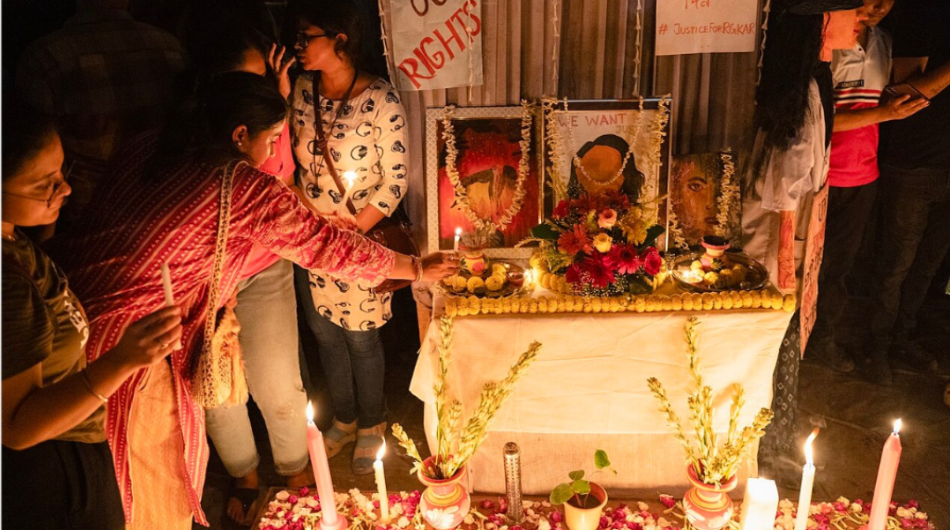
    The case sparked mass protests in mid-August 2024 when tens of thousands marched under slogans like “Hang the rapist, save women” and “Reclaim the Night”. Medical students and staff across India held a strike; emergency services continued, but routine procedures were halted on 17 August by IMA’s nationwide shutdown.

    Even after the recent trial and verdict, many junior doctors staged demonstrations outside the court. Immediately following the life-sentence verdict, doctors outside the courtroom protested that Roy could not have acted alone and demanded that all accomplices be caught.

    The case has drawn parallels to the 2012 Delhi Nirbhaya gang rape incident, highlighting ongoing concerns about women’s safety in India and prompting discussions on legal reforms in handling crimes against women. As India continues to confront the layered realities of gendered violence, this case remains a point of inflection. It demands that hospital corridors be made safe, that survivors’ voices be heard without delay, and that justice not be left to the whims of public outrage alone.

  • Hindenburg Research Calls it Quits: The firm that shook financial empires leaves the arena

    Hindenburg Research Calls it Quits: The firm that shook financial empires leaves the arena

    As 2025 started with a flurry of events, it also marked the end of an era. Amid controversies, the US-based short-selling firm, Hindenburg Research, which attracted worldwide interest due to its short-selling strategies, and more importantly, the reports that led to the loss of billions of dollars for the India-based Adani group, announced its decision to cease operations on 16 January 2025. The company that had charged more than 100 individuals through their work has decided to mark an end to its run.

    Founded by Nathan Anderson in 2017, Hindenburg Research was an investment research firm that exposed corporate fraud and financial scams. The short-selling stock firm grew in prominence in India and made international news after it published a report alleging that the Adani Group was involved in financial malpractices. The 30,000-word report titled ‘Adani Group: How The World’s 3rd Richest Man Is Pulling The Largest Con In Corporate History’ released in January 2023, caused international waves as it exposed the company of being involved in numerous breach of ethics, such as financial irregularities, stock manipulation, improper tax havens and high levels of debt within the company.

    In a personal note, Nate Anderson shared that they had been planning to shut down since 2024 and that there was no specific reason behind the decision. Although he cited completing all his goals as one of the reasons that led to the decision to shut down, he also mentioned how it is time for him to move on. “I now view Hindenburg as a chapter in my life, not a central thing that defines me,” he stated in the note.

    Anderson, with minimal capital, no background in finance, and three lawsuits up his sleeve, did not have an easy road to success. He went into detail about how the journey has also been intense and, at times, all-encompassing. The founder considers his journey to building the firm “nothing less than a dream.”

    The Adani saga that the Hindenburg was involved in was nothing short of a spectacle that led to Gautam Adani losing the title of Asia’s richest man, which resulted in investigations for a long time. Although the company denied all allegations, it still caused a massive sellout, wiping almost $150 billion from its stock value. Hindenburg didn’t stop at this and went on to slam allegations against the SEBI group, accusing the SEBI chief of having links to offshore hedge funds, which are allegedly linked to the multi-billion-dollar Adani Group.

    While they shook financial empires in India after the report, Hindenburg gained global attention much earlier in 2020 after they were involved in a high-profile case where they accused Nikola, an electric truck maker owned by Trevor Milton, of misleading investors about the technology they used.

    While the company has decided to cease operations and is planning on exiting, they’re far away from leaving the spotlight. According to some documents filed in a court case in Ontario, Anderson has been under scrutiny for alleged connections to hedge funds in preparing reports that targeted companies. According to the Market Frauds Portal, there has been an alleged collaboration between Hindenburg and Hanson funds in preparing reports. Due to a lack of disclosure about such a collaboration, the US Securities and Exchange Commission (SEC) could charge them with securities fraud.

    As the short-selling firm exits the scene, its legacy will remain engraved in controversies.