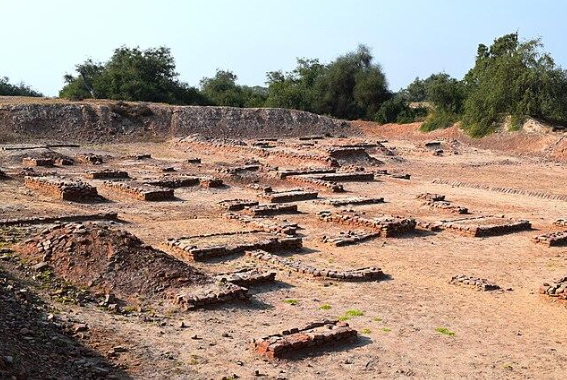
Thousands of years ago, the Harappan Civilisation stood among the world’s first urban societies. Cities like Harappa, Mohenjo-Daro, Dholavira, and Lothal were equipped with well-laid-out streets, advanced water and drainage systems, and thriving business workplaces. Yet by the end of the third millennium BCE, most of this advanced civilisation had vanished, its cities abandoned. For decades, historians and archaeologists debated why. However, a major study now suggests a possible answer: prolonged droughts.
Published in the journal “Communications Earth & Environment,” the research involved scientists from IIT Gandhinagar, the University of Arizona, and the University of Colorado Boulder, who combined climate simulations, lake-level records, and cave minerals to reconstruct how water availability changed across the Indus Valley between roughly 5,000 and 3,000 years ago.
The team examined the paleoclimatic records for 17 major Harappan locations and used the Variable Infiltration Capacity (VIC) hydrological model to estimate river flow. In simple terms, they utilised ancient climate data and the VIC model to recreate the climate 4,000-5,000 years ago and examine how major rivers, including the Indus, exhibited changes or unusual drops in water discharge. The simulated climate data and calculations for river flow in the IVC indicated reduced streamflow, which was crucial for irrigation and domestic use.
A Civilisation Built Around Water and the disappearance of water
The Harappans lived in a region heavily shaped by rivers and the monsoon. Their farms depended on seasonal floods, and cities were built near water sources. This system worked beautifully for centuries. Decent rainfall meant a wealthy society. Rivers like the Indus and even the Saraswati were key sources of water for this civilisation.
A new study suggests that approximately 4450 and 3400 years ago, the region experienced distinct, prolonged droughts, each lasting more than 85 years. They discovered that one of the key droughts had lasted for 113 years. During these periods, monsoon rainfall dropped sharply, causing rivers to shrink and water sources to become scarce.
These droughts led to a decline in agricultural activities. Urban systems began to weaken, and the large drainage networks, public wells, and storage facilities became increasingly difficult to manage. Like any other civilisation, population pressure rose sharply.
A Slow Transformation, not a Sudden Collapse
One important point that the researchers emphasised is that the Harappan Civilisation did not disappear overnight. There is no major evidence of war, destruction, or invasion. As water became scarce, people began moving away from the big cities. Many shifted eastward, towards the Ganges Plain, which is one of the most fertile regions. Others settled in smaller villages that relied on simpler, rain-based farming rather than river- or flood-based farming. The famous baked-brick architecture of Harappan cities gave way to more modest settlements. The collapse was not sudden; it was a steady change in lifestyle from urban, planned cities to scattered rural villages.
Why the new Findings Matter
The breakthrough reveals the close interdependence of human societies on the environment. The Harappans were highly skilled builders and planners, but they were still dependent on rainfall. When the climate shifted over centuries, even their highly advanced systems could not adapt. The findings also clarify long-standing theories. For years, people have believed in various theories, such as invasions or sudden disasters, that could have led to the end of the civilisation. However, the evidence now suggests a slow, climate-driven decline. This study helps not only in understanding the past, but also in understanding the climate, resilience, and how societies today can find themselves in a similar position if we do not take action to protect the environment.
Leave a Reply