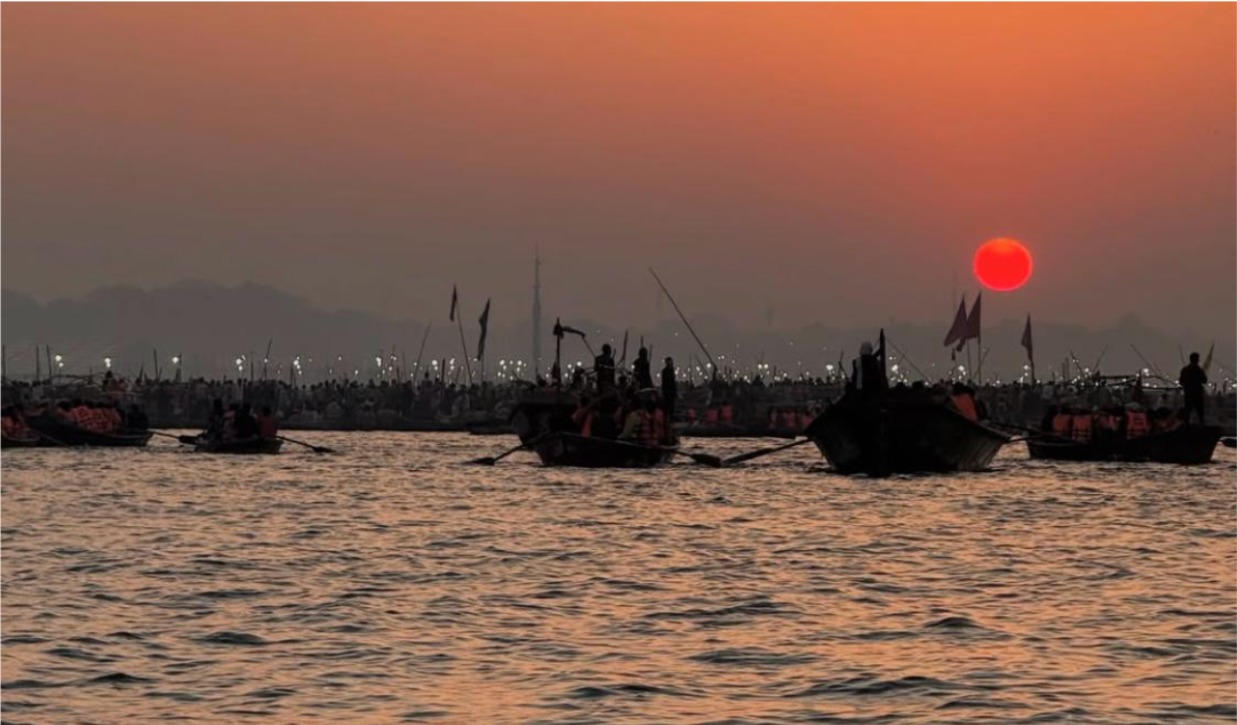
Life is filled with curves and circles, looping through birth, death, and rebirth. Each soul is affected by karma and longs for release, Moksha. In this journey for liberation, only once every 144 years comes a moment when the heavens align. This moment is the Maha Kumbh Mela, a spiritual phenomenon where millions gather to cleanse their sins, dissolve their egos, and connect with something far greater than themselves.
At the heart of this divine convergence is Triveni Sangam in Prayagraj, the sacred convergence of the Ganga, Yamuna, and Saraswati. According to ancient scriptures, this Sangam is not just a sacred place where these rivers meet, but it is a doorway to spiritual awakening. A dip in these holy waters during the Maha Kumbh is said to wash away lifetimes of accumulated karma, breaking away from the very cycle of life and death.
When the Sun, Moon and Jupiter align, it is believed the rivers become charged with Amrit, the divine nectar of immortality. There existed a time when the universe itself was in a state of instability. The Devas (gods) and Asuras (demons) joined forces to churn the cosmic ocean in pursuit of Amrit. As the pot of Amrit emerged, chaos unfolded. To protect it from falling into the wrong hands, Lord Vishnu, in the form of Mohini, whisked it away. In the celestial fight that followed, four drops of Amrit fell on Earth, Prayagraj, Haridwar, Ujjain, and Nashik. These four cities became sites of sacred convergence. And thus, the Kumbh Mela was born.
“In the eternal churn of the cosmos, gods and demons wrestled not for gold or land, but for a drop of immortality.”
But the Maha Kumbh is not just about myths. It is also a breathtaking display of humanity. Over 400 million people visited from all corners of the world, rich and poor, saints and sceptics, to participate in this unfathomably vast gathering. Temporary cities rise on the riverbanks, complete with roads, clinics, tents, and sanitation, all for a few sacred weeks. The air hums with chants, conch shells, and the scent of incense, forming a sensory experience unlike any other.
Leading the way into the waters are the Naga Sadhus, warriors devoted to Lord Shiva. Covered in ash, with matted hair and tridents in hand, they march nude and unbothered, a living challenge to the materialistic world. For many pilgrims, witnessing the Nagas is as transformative as the dip itself.
And then there is the spirit of seva, selfless service. Bhandaras, or community kitchens, are set up on every lane of the city. Here, everyone eats for free. Volunteers, often anonymous and unpaid, serve hot meals from sunrise to nightfall. There is no caste, no status, only humanity sharing a meal together. It is extraordinary kindness on a massive scale, showing that devotion does not just lie in prayer, but in action.
The Maha Kumbh Mela might appear, at first glance, like overwhelming chaos – crowds of people surging into muddy rivers, noise echoing in every direction, giving one no space to breathe. Yet, for those who stand on the riverbank, it becomes something else entirely. It feels like everything has a purpose, as if there is a deeper meaning beneath the surface.
When you step into those cold waters, you are not just taking a bath. You’re letting go of stress, guilt, regret, or even ego. You’re washing off layers of your past. And in that moment, as the river flows around you, you don’t just feel clean, you feel light, open, and somehow… free.
Image Source: Official Instagram Handle/ @mahakumbh_25
Leave a Reply