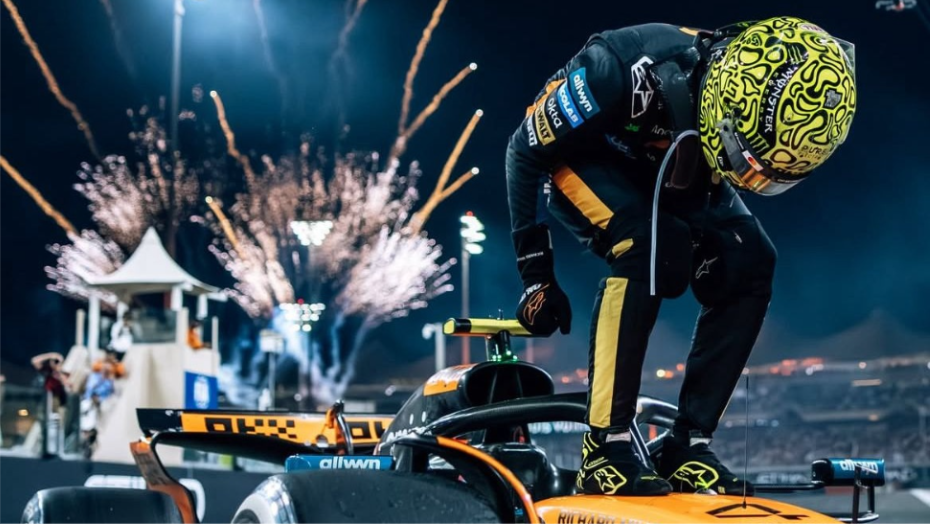
The 2025 Formula 1 season has come to an end, with Lando Norris securing his first World Drivers’ Championship after a consistent and closely contested campaign. The McLaren driver finished the year with multiple wins and regular podium finishes, allowing him to edge out Max Verstappen in the final round, the Red Bull driver finishing only two points behind in second.
The season was kickstarted with a celebration of Formula 1’s 75th anniversary, a live event hosted in London’s O2 Arena, where all 10 teams showcased their brand new liveries. For the sport itself, races were sold out months in advance, TV and viewership surged, while social media platforms were gaining popularity. The calendar remained one of the busiest on record, featuring 24 races and several sprint events distributed across various venues across the world.
The season was dominated by McLaren, where, with an updated car, their mid-2020s rise, which began with incremental upgrades in 2023 and 2024, became a full-fledged championship contention this season. After a season-long battle marked by multiple wins, several shifts in the points lead, and close competition with teammate Oscar Piastri and Max Verstappen, Lando Norris emerged as the title champion. Despite setbacks including collisions, penalties, reliability issues, and a late disqualification in Las Vegas, Norris kept himself in contention through consistent podiums and key victories in Monaco, Austria, Britain, Mexico, and São Paulo. He regained the championship lead in the final phase of the season and ultimately sealed the title with a third-place finish in Abu Dhabi.
While Norris emerged as the championship leader, Oscar Piastri’s results prompted debate among fans and analysts. Piastri led the standings for the majority of the season before facing a slump in the second half, going from a 34-point lead over Norris to being 25 points behind with two races remaining. Some argued that strategic misalignments and reliability issues hindered Piastri at key moments, leading to claims that McLaren had not fully balanced its support between the two drivers. His struggles also drew mixed opinions on McLaren’s highly adaptable 2025 car playing a decisive role in the championship.
Max Verstappen mounted a comeback in the final phase after being 104 points behind after the Dutch Grand Prix. A strong run of results across the closing rounds reduced the gap significantly, and he reached the Abu Dhabi season finale just two points behind the championship leader. Verstappen ultimately finished the season as runner-up after falling short in the final race.
Another notable event was Lewis Hamilton’s first year with Ferrari. Finishing sixth this year, inconsistencies in tyre management and pace prevented better performances. Hamilton finished with zero podiums (albeit one sprint win in China), becoming the first new Ferrari driver in 44 years to do so. Nevertheless, Ferrari viewed the season as a foundational step toward stronger performance under the upcoming regulation changes.
The new regulation rules, set to take effect in the 2026 season, are aimed at making the cars more agile, safer and sustainable while maintaining their competitiveness. The cars will be lighter and smaller (a 30 kg weight reduction), with a redesigned hybrid power unit that increases the role of battery power and incorporates advanced sustainable fuels. Active aerodynamics, including movable front and rear wings, are being introduced to promote closer racing and reduce reliance on the current DRS system.
In addition to these changes, there will also be a restructure of the teams and also an addition of an 11th team, Cadillac, with veterans Valtteri Bottas and Sergio Perez joining the F1 grid again. Audi will fully take over Sauber, while Arvind Lindblad will join Racing Bulls with Liam Lawson, in place Isack Hadjar who in turn replaces the outgoing Yuki Tsunoda to become teammates with Max Verstappen.
Overall, the 2025 season delivered a new world champion, highlighted continued growth in Formula 1’s global reach, and marked the closing chapter of the current regulatory era. With teams now shifting focus toward 2026, the coming year is expected to redefine competitive order once again into the next phase of the sport.
Leave a Reply