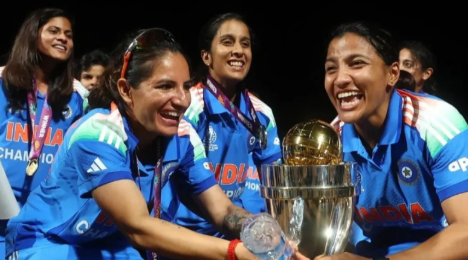
In a historic night at the Dr DY Patil Stadium in Navi Mumbai, the Indian women’s cricket team clinched their first-ever World Cup title, defeating the South African women’s cricket team by 52 runs in the final. The victory marked a historic achievement for the Indian team, which had previously reached the finals in 2005 and 2017 but fell short on both occasions.
Match Summary
India won the toss and chose to bat, posting a total of 298 for 7 in 50 overs. Shafali Verma scored 87 runs off 78 balls, providing a strong foundation with a 91-run opening partnership with Smriti Mandhana, who contributed 44 runs. In the middle order, Deepti Sharma added 58 runs, stabilising the innings after a brief slump during the middle overs.
For South Africa, Ayabonga Khaka was the most clinical bowler, taking three wickets for 57 runs, while Marizanne Kapp maintained tight control in the death overs.
In the second innings, South Africa fell short of the target, getting dismissed for 246 runs in 45.3 overs. Skipper Laura Wolvaardt scored a century (110 runs off 127 balls), but the rest of the batting order struggled to maintain partnerships. Renuka Singh Thakur took three wickets for 40 runs, and Deepti Sharma picked up two wickets, completing a strong all-round performance.
Shafali Verma was named Player of the Match for her contribution with both bat and ball, while Deepti Sharma was named the Player of the Tournament award for consistent performances throughout the World Cup.
India’s Path to the Title
The Indian Women’s Team had a strong run, leading their group in the league stage and winning six of their seven matches, including victories over Australia, England, and New Zealand.
In the semi-final, India beat Australia by 17 runs at the Wankhede Stadium. Shafali Verma scored 74 runs, and Renuka Singh took four wickets, which were key to their success. The final win against South Africa marked India’s first world title in women’s cricket after many years of coming close.
Team Composition
The core group included Harmanpreet Kaur (captain), Smriti Mandhana (vice-captain), Shafali Verma, Deepti Sharma, Richa Ghosh (wicketkeeper), and Renuka Singh Thakur. The bowling attack combined pace and spin effectively, with Pooja Vastrakar, Rajeshwari Gayakwad, and Shreyanka Patil contributing at crucial stages. Pratika Rawal, one of the youngest members of the team and a batting all-rounder, played a pivotal stabilising role in the middle order, scoring 308 runs (the second highest run scorer) before an unfortunate injury during the match with Bangladesh, which ruled her out of the final.
Harmanpreet Kaur, in her third World Cup as captain, provided tactical consistency and led the team to its most successful global campaign. The fielding unit, traditionally an area of concern, showed marked improvement through tighter positioning and reduced errors.
Conclusion
India’s 2025 ICC Women’s World Cup victory represents a significant moment in both sporting and institutional terms. Beyond the immediate celebrations, the challenge now lies in sustaining momentum through continued financial and infrastructural support. If maintained, the 2025 triumph may stand as the foundation of a new era for women’s cricket; one in which India is not only a participant but a defining power in the sport.
Leave a Reply