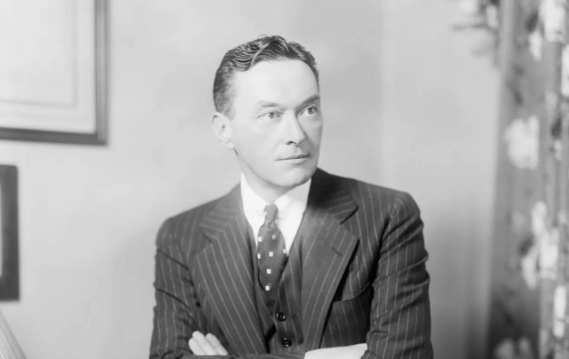
Among the pantheon of American journalism, few figures hold as much weight as Walter Lippmann. For over half a century, he was the country’s leading interpreter of politics, war, and democracy: an intellectual go-between bridging the raw chaos of events and the public trying to make sense of them. He was not only a columnist, he was a thinker who grappled with questions that are still pressing today: How do we know what we know? What is the role of the press in presenting our vision of reality? And can democracy persist if its citizens are captives of illusion?
Lippmann’s career spanned from the Progressive Era to the television era. Along the way, he invented modern political commentary, coined terms that have become the foundations of media theory, and commanded the attention of presidents as much as the readers of his daily column. To grasp Walter Lippmann is to learn the strained marriage of democracy and information in the 20th century, a marriage that remains under tension today.
A New Yorker in the Making
Born in 1889 to an affluent German-Jewish family in New York, Lippmann grew up musically gifted, well-travelled, and bookish. His passion for ideas led him to Harvard, where he studied philosophy under William James and George Santayana.
Harvard was the turning point. Learning about pragmatism, which revolves around ideology being proved and tested in practice, took his perception of politics to great heights: his views on it were not dogmatic but instead an ever-evolving process. He graduated in 1910 as a man with starry eyes and a burning ambition to introduce firebrand ideas to a world that was standing at the door of revolution.
The early 20th century brimmed with reform movements: investigative journalists exposed corruption boldly as progressives clamoured for reform, and politicians only added to it by grappling with America’s emerging global stronghold. Lippmann slid into this ferment easily. By 1913, Walter Lippmann, who was 24 at the time, co-founded The New Republic, a journal carrying opinions that quickly emerged as the voice of progressive intellectuals. His first central forum was employed to press the case for domestic reform and reflective engagement overseas.
The Interpreter
Lippmann’s voice drew a parallel between fiery crusaders like Upton Sinclair and caustic critics like H.L. Mencken as he treaded towards a calmer, analytical voice that remained relentlessly focused on clarity. His presence in journalism was less of a partisan and more of an interpreter, helping readers make sense of events too complex to grasp on their own.
That instinct was expressed in his syndicated newspaper column, Today and Tomorrow, which debuted in 1931. It appeared for more than three decades in hundreds of newspapers all over the nation, reaching millions. Every important person within the nation gave close attention to Lippmann’s verdicts.
His authority of trust came from his scholarship and his independence. Lippmann never had trouble changing his mind when the facts required it. His parallel opinions, whether it was about his support of Woodrow Wilson’s entry into the First World War, all while scrutinising the League of Nations, expressing his due respect to FDR, but criticising the anatomy of the New Deal, or even encouraging the Cold War containment at the same time, cautioning America against excess militarisation. His allegiance was not always to the party line but to his idea of truth.
Public Opinion and the Shadows on the Wall
Lippmann’s best and most lasting work did not come from his daily columns but from his books. In Public Opinion (1922), he provided a groundbreaking analysis of how people come to know the world. Underlying it was a simple yet radical notion: most of what we understand comes not through direct experience but through mediated images, news accounts, and stereotypes. He referred to this manufactured reality as the “pseudo-environment.” It is through this lens, not unmediated reality, that people form their judgments. The implication was unsettling. If citizens see the world only in terms of such shadows, democratic choice is tenuous. As Lippmann wrote, “the pictures inside people’s heads do not correspond with the world outside.”
This was more than a philosophical comment but a political alert. Democracy, he maintained, could not rely on citizens’ understanding the complexities of contemporary policy. His answer was drastic: turn over interpretation to experts, specialists, and institutions. Elitism was the accusation of his critics, but Lippmann justified the position as realism. “The common interests,” he said, “very largely elude public opinion entirely, and can be managed only by a specialised class.”
Struggling with Democracy
This conflict between the ideals of democracy and the murky realities was a constant presence in Lippmann’s life. He trusted in self-government but suspected that common people were not always capable of making sound judgments. He prized the press but observed how it could deceive, and although he loved freedom, he was critical of propaganda’s corrosive influence- particularly after observing its growth under fascism.
In World War II, Lippmann stood among the loudest voices saying that Americans had to resist Hitler, lest they themselves become postwar authoritarians. In the Cold War, he supported containment but warned that hysteria at home threatened democracy more than communism abroad. He opposed McCarthy with fact-based critiques, not fear.
His opposition never ceased accusing him of being aloof or too detached from the fervours of democratic living. But his apologists recognised in him something unusual: a commentator who would speak what was hard, even unpopular, if he thought it was supported by reason.
The Journalist as Philosopher
In the mid-century period, the height of Lippmann’s persona was his transcendence into public philosophy. He earned two Pulitzer Prizes for commentary, was honoured with degrees from universities across the globe, and was accepted as the dean of American political commentary in general. But he lived with restraint, afraid of being lionised.
Later in his life, he became increasingly suspicious of the ascendancy of television. He was concerned that the medium, which rested on image and spectacle, would further exacerbate the distortions he had predicted in Public Opinion. In later years, he feared television’s reliance on image would turn politics into theatre, a prophetic concern in today’s age of 24-hour news and social media.
When Lippmann passed away in 1974, obituaries greeted him as a giant of journalism, a figure who had not only defined how Americans saw their world but also how they saw the act of seeing it at all.
Lippmann’s Legacy in the Digital Age
It is essential to revisit Walter Lippmann’s work today to observe the questions he posed that have been responsible for only sharpening the digital era we live in now. If his newspapers could construct pseudo-environments, what of today’s algorithmic feeds, where millions reside within self-supporting bubbles of disinformation?
His “pictures in our heads” resonate in every argument over fake news, echo chambers, and disinformation campaigns. At such a time when we as a society struggle to cope with climate change, pandemics, and technological disruption problems, Lippmann’s contention comes right into relevance as he remarks that just as democracy is dependent on freedom, similarly, a news platform’s competence is equally dependent on producing sound bites that revolve around such issues of global importance.
Naturally, his appeal for expert governance is still contentious. The populist protest of our era indicates that citizens often reject the notion of being governed by elites. Even so, his detractors acknowledge that he compelled democracy to face its blind spots. Naming the illusions we live by, he provided us with the means to resist them.
The Final Word
Walter Lippmann was a man of contradictions: a democrat wary of mass opinion, a journalist sceptical of the press, an optimist who often warned of failure. Yet within these tensions lay his genius. He educated the public not what to think, but how to think about thinking. His voice has since stilled, but his questions remain. In a world filled with shadows and images, we might need him today more than ever.
Leave a Reply