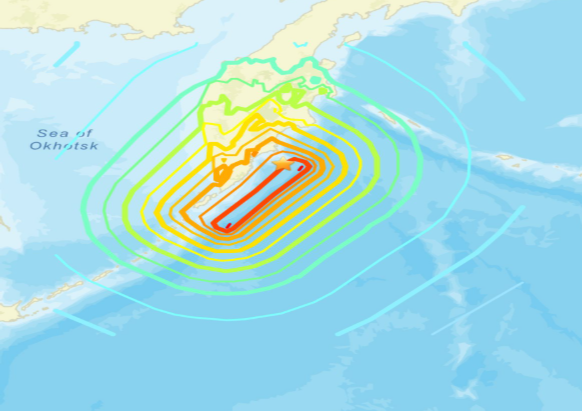
The United States Geological Survey (USGS) stated that the quake was at 23:24 UTC (05:54 IST, 30 July), some 119 km southeast of Petropavlovsk-Kamchatsky, an urban municipality in Kamchatka Krai. The earthquake was of relatively shallow depth of 19 kilometres, which maximises its capability to cause surface effects.
The quake struck near Petropavlovsk-Kamchatsky, close to a volatile underwater fault line where tectonic plates constantly battle for dominance — the Kuril-Kamchatka Trench, infamous for past megaquakes.
The ground trembled. Sirens cried out. Millions rushed to the top. A strong 8.8-magnitude earthquake off the Kamchatka Peninsula in Russia late 29 July sent shockwaves across the Pacific Rim and prompted widespread tsunami warnings from Chile to Japan. The quake, which was one of the most powerful in more than ten years, triggered a worldwide series of evacuations, emergency responses, and a tense wait for impact.
Epicentre and Geological Details
The United States Geological Survey (USGS) stated that the quake was at 23:24 UTC (05:54 IST, 30 July), some 119 km southeast of Petropavlovsk-Kamchatsky, an urban municipality in Kamchatka Krai. The earthquake was of relatively shallow depth of 19 kilometres, which maximises its capability to cause surface effects.
The quake struck near Petropavlovsk-Kamchatsky, close to a volatile underwater fault line where tectonic plates constantly battle for dominance — the Kuril-Kamchatka Trench, infamous for past megaquakes.
Tsunami Warnings and Evacuations
In less than ten minutes, the Pacific Tsunami Warning Centre (PTWC) came online and sent out warnings for countries in the Pacific, including French Polynesia, Japan, Chile, Hawaii, California, Alaska, Ecuador, Peru, and Colombia. Among the coordinated responses were that Japan evacuated almost 2 million people from coastal prefectures; one person died due to the evacuation efforts. In the coastal areas of Chile, the evacuation involved more than a million people due to “red alerts”. Hawaii declared an emergency, closed ports, rerouted traffic, activated statewide sirens, and opened public shelters.
Western U.S. states, ranging from California to British Columbia, issued tsunami advisories; Crescent City in Northern California issued a warning about potential wave amplification due to underwater topology, despite the fact that actual wave heights were recorded at just over 1 foot (~0.3 m).
By 31 July, the majority of regions had reduced or revoked warnings; Chile remained on alert, New Zealand kept coastal areas off-limits, and other countries adopted cautious advisory stances.
The United Nations Office for Disaster Risk Reduction (UNDRR) attributed the quick, synchronised response of the governments and the emergency services to “effective early warning systems and evacuation protocols.”
Initial Impact and Damage Reports
Even though the earthquake was very powerful, no fatalities have yet been reported as of August 3. Russian officials in the Far East reported minor injuries, minor damage to buildings and power supply disruption in certain areas. Kamchatka Krai and portions of Sakhalin Oblast are yet to be physically inspected.
Russian rescue forces were sent during the night, and the local authorities declared a state of heightened alert. However, the isolation of the epicentral region most likely limited casualties.
Nuclear and Military Facility Concerns
What rattled beneath the surface may have shaken more than just the earth. Some of Russia’s most classified military facilities, including naval bases thought to contain nuclear submarines, were dangerously close to the epicentre. As international intelligence services step up satellite surveillance in search of any indication of structural damage or compromised security, the Russian Defence Ministry’s silence has only stoked rumours. The earthquake has caused anxiety well beyond seismic circles in an area already shrouded in military secrecy.
Global Seismic Significance
The July 29 earthquake ranks as the world’s second most powerful earthquake after Japan’s 2011 Tōhoku earthquake, which had a magnitude of 9.1 and caused a devastating tsunami. It is currently the sixth most powerful earthquake to be registered by seismographs since the year 1900.
Seismologists believe this movement is possibly part of a broader Pacific Ring of Fire tectonic process that will continue to have aftershocks for weeks.
International seismic safety protocols are receiving more attention as a result of this incident. Budget cuts are a concern; experts stress maintaining and increasing funding for organisations like PTWC, which are essential to early warning effectiveness. There is growing support for regular simulation drills, public education campaigns, and better coordination among national meteorological, defence, and disaster management agencies, especially in areas vulnerable to megathrust earthquakes. Talks have started about extending reliable early-warning systems into under-monitored regions, particularly the Atlantic Ocean basin and Indian Ocean zones, beyond current networks.
Although the Kamchatka earthquake did not cause significant damage relative to its strength, specialists highlight that it serves to highlight the ongoing seismic danger for countries along the Pacific. Authorities are reminding people who are in risk areas to be aware of safety protocols, especially since aftershocks and secondary risks can still materialise
Leave a Reply