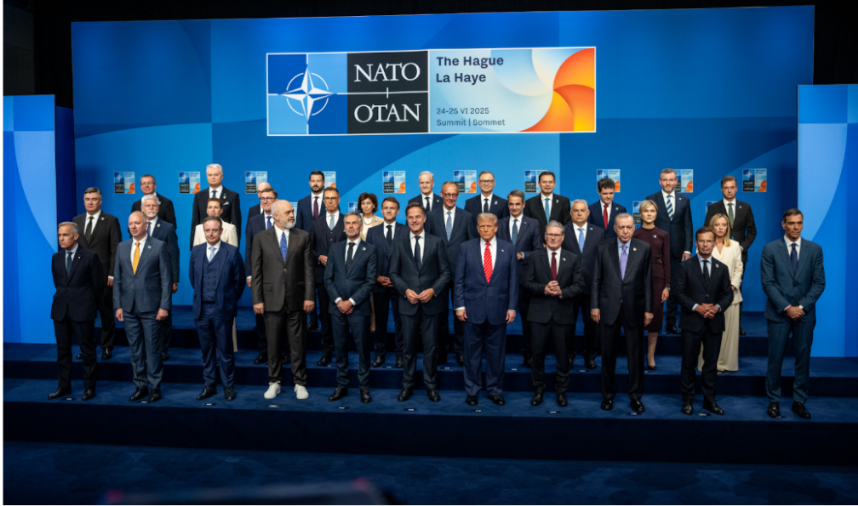
In the 2025 North Atlantic Treaty Organisation (NATO) Summit held from 24 June to 26 June, a strong commitment was made by all the NATO countries. The member states have finally agreed to ramp up their defence spending goal to 5% of their gross domestic product (GDP) by 2035, a major jump from the previous target of 2% set in 2014.
The US president has raised questions about NATO’s collective defence strategies for several months now, narrowly referring to Article 5 of NATO’s Alliance in his defense, which states, “An armed attack against one or more of the allies shall be considered an attack against them all. Trump has avoided explicitly endorsing the clause, claiming there are “multiple definitions of Article 5,” a move seen by many as an effort to avoid confrontation with Russia.
In response, NATO has worked towards a compromise, agreeing to increase defence spending to keep the U.S. engaged in the alliance. The 32 countries have decided to dedicate 3.5% of their GDP to crucial military needs and 1.5% to other elements such as cybersecurity, infrastructure, etc.
NATO has publicly stated that the alliance must work towards deterring Russia’s military force. “NATO needs a “quantum leap” in defence to deter threats to the alliance”, Rutte mentioned in a speech given in London, earlier this month. Thus, he urged member states to invest more funds towards defence.
Trump went on Truth Social to share a message sent to him by NATO Secretary-General, Mark Rutte. In the message, Rutte acknowledged that Trump has driven NATO towards a very important global decision. He also added that Trump has “achieved something NO American president in decades could get done.”
A New York Times report highlights that Trump has previously bashed NATO for not allocating adequate funds for defence, particularly in the face of threats like Russia. During his first term, Trump had threatened that the USA would exit the NATO alliance. Experts believe that Trump may be undermining NATO from within and that this dramatic agreement was primarily made to ensure that the USA remains an enthusiastic participant in NATO.

Image Source: WhiteHouse/ @x.com
However, not all 32 countries were satisfied with this decision. Spain’s Prime Minister, Pedro Sanchez, had sent a letter to Mr. Rutte saying that Spain “cannot commit to a specific spending target in terms of GDP.” Sanchez insisted that Madrid would need only 2.1% percent of GDP to acquire and maintain all the personnel, equipment, and infrastructures requested by the alliance to confront these threats with their capabilities.
As a result, every member state will not be forced to reach the 5% threshold; however, there are some standard military requirements that every country is required to meet. Trump vowed that he would make Spain pay for this “terrible” decision. “I like Spain … It’s a great place and they’re great people. But Spain is the only country out of all the countries that refuses to pay. And, you know, so they want a little bit of a free ride, but they’ll have to pay it back to us on trade because I’m not going to let that happen,” Trump said.
This commitment was shaped as much by the strategic urgency felt by all 32 countries within the NATO alliance. As they rush to present a united front, a divide is forming within the coalition itself. As key participants like Spain are raising their voices against major players like the US.
Leave a Reply