Category: Art, Culture and Entertainment

  • Norman Conquest: A Progressive Shift in English

    Norman Conquest: A Progressive Shift in English

    English has become the lingua franca of the world. It enjoys a status like no other language, but if we delve into its history, we’ll find a time when the status of English plummeted.

    As a Germanic language, English shares a common ancestry with languages like German and Dutch. Yet, it consists of a large number of loanwords (words borrowed from a foreign language) from various languages like French and Spanish, which are called “Romance languages” (languages descended from Vulgar Latin). For instance, the word “cry” was derived from French.

    Around a thousand years ago, the language spoken in England was Old English, which would be utterly incomprehensible to us today. Take the epic poem Beowulf, for example. This renowned work of Old English literature, likely written before the 11th century, recounts the heroic adventures of its namesake, Beowulf. The opening lines, “Hwæt! We Gardena in geardagum, þeodcyninga, þrym gefrunon, hu ða æþelingas ellen fremedon,” seem almost alien to modern English speakers. Yet, this language evolved over centuries into the English we speak today.

    Beowulf manuscript from the British Library / Source: Wikiemedia Commons

    This brings us to the Norman Conquest, which resulted in the assimilation of French words into English. Nearly a millennium ago, the Vikings settled in northwest France and established the Duchy of Normandy under a treaty with the King of France. These settlers, known as Normans, adopted French culture and began speaking French in a distinctive dialect called “Norman French”.

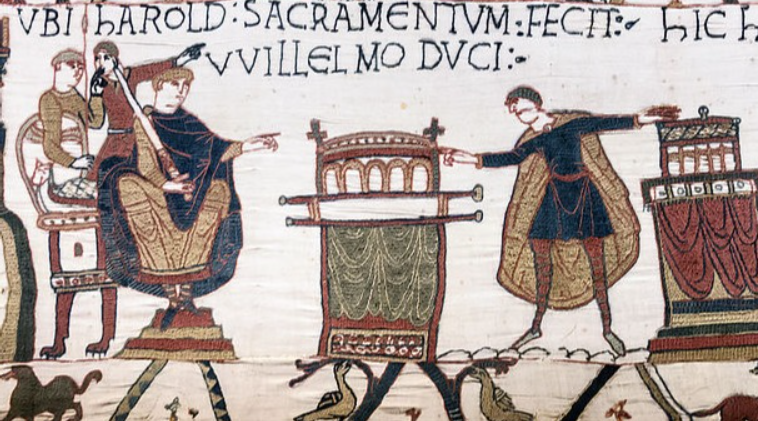
    English took a dramatic turn when William, a descendant of these Viking settlers, became the Duke of Normandy. After the death of the King of England in AD1066, Edward the Confessor, William claimed that he was named the heir to the English throne by Edward, his distant cousin. However, Harold, Earl of Wessex, assumed the throne instead. As a result, William launched a bold invasion of England and defeated Harold at the famous Battle of Hastings, which completely altered the fate of English. The reign of William brought significant political, economic and social change to England.

    Years after the beginning of his rule, he commissioned the Doomsday Book, a country-wide census to record the details of all land in his kingdom. This was written in Latin, and the meanings of many rights and laws were changed. Additionally, words and concepts that were new to England were used. However, the book was never translated into English, so any explanation of the changed meanings of the rights and laws was almost inaccessible to the English speakers of England.

    William established Anglo-French as the language of public state business and the court, along with Latin. Law codes written in Old English were altered by adding French phrases, paving the way for French in English legal practice. William brought the French aristocracy to England, which created a French-speaking upper class. They could not affect the general speech but could influence the elite class, as the literacy rates in England were low at that time. Eventually, English became the language of the commoners as the nobles switched to French. Nonetheless, French was the official language, so French loanwords found their way into English. For example, the word ‘throne” was derived from the French word “trône”.

    Nearly 200 years later, French gained more momentum in England. French became attractive to the general public as it was the primary language of the aristocracy, leading to more French words and expressions being included in the English lexicon. Moreover, new words were coined from combinations of French and English words. Similarly, words were formed by adding French affixes and roots to Old English words. For instance, the combination of the English verb “hinder” and the French suffix “-ance” created the noun “hindrance”. In the evolution of English, the Norman Conquest resulted in the beginning of a new era of English – Middle English, that lasted until around AD1500, and it was around this period that English started gaining prestige.


  • Devakoothu: How women are challenging norms in a male-dominated art form

    Devakoothu: How women are challenging norms in a male-dominated art form

    Amid the wailing sounds of children crying, the shrill kuzhal being played, and the rumbling sound of a chenda, the loud footsteps echo. As the crowd gathers at the Koolom Thayakavu temple in anticipation, a red figure makes her way through the swarm. While she performs in front of the people, Ambujakshi looks majestic; the performance is divine. She is no longer herself; Valliamma, the goddess, has taken over. 

    In the artistically rich state of Kerala, Theyyam is performed predominantly in the North Malabar region. Although Theyyam has been traditionally practised by men since ancient times, there exists one form which is performed solely by women. Devakoothu , performed in the Thekkumbad Kulom temple in the district of Kannur, is based on a myth about a goddess who got lost in the island. 

    Due to a lack of records, the exact period during which the art was developed is unknown, but according to the people, it is believed to be centuries old. 

    Legend has it that devakoothu is rooted in a tale that tells the story of injustice towards a goddess. According to the tale, once, while a group of devathas (goddesses) were walking through devalokam (heaven), they came across an island on earth filled with intoxicating flowers. While the goddesses were making their way through the creepers in search of the flowers, they got lost. All goddesses except one made it out. The trapped godess, who was saved by a villager, prayed to Narada, who took the deity to Koolom. Even after returning to devalokam, her fond experiences on Earth stayed with her. Once in every two years, in the month of Dhanu, she visits the island to meet and bless the people. 

    Among the few women who choose to practice Devakoothu, Ambujakshi of Malayanvalappi is a woman who holds a special place to the people of Thekkumbad. She started performing at the age of 45, after Kattuparambil Lakshmiyamma, who performed the art for almost fourteen years, decided to retire from the stage. Ambujakshi, who was a sweeper at the Post Office, took on the mantle and performed for the first time in 2012. She had to observe a 41-day penance, during which she would wake up early, recite the mantras to evoke the god and practise for the performance. Currently, MV Ambujakshi is the only woman who is practicing the art form. 

    Devakoothu is not merely a spiritual form of expression. Being the only form of theyyam performed by women out of the 456 forms that exists, Devakoothu breaks barriers and challenges the norms set by theyyam itself. The presence of women in male-dominated art forms has been showing a shift in the recent times, and this specific form of art challenges the sanctimony of certain art forms. Women like Ambujakshi being in the forefront, reclaiming their places in the cultural forms, gives a reminder that women have also been an integral part of it and will continue to be.

  • A Journey through Chettinad Heritage and Craftsmanship

    A Journey through Chettinad Heritage and Craftsmanship

    Legend has it that within the walls of the mansions of Karaikudi lie hidden treasures, carefully concealed by the wealthy Chettiars to protect their fortunes from invaders. Rumours of ghostly apparitions drifting through the corridors only add to the intrigue as residents and visitors share stories of eerie encounters and unexplained phenomena. But it’s not just the supernatural that lurks within the walls of these opulent homes. Behind the façade of wealth and splendour lies a darker history of family feuds and betrayals. Sibling rivalries, clandestine affairs, and secret alliances are whispered in hushed tones, their echoes reverberating through the halls. Yet amidst the tales of curses and hexes, there is also a sense of awe and wonder at the architectural marvels that testify to the craftsmanship and ingenuity of the Chettiar builders. Each mansion tells its own story through its unique blend of indigenous and colonial styles, its hidden symbols and motifs hinting at mysteries yet to be unravelled.

    Initially a part of the Pandiyan Dynastry and later under the rule of various dynasties such as the Cholas, Cheras and Pallavas, Karaikudi is tied to the Nattukottai Chettiar community. The Chettiars were renowned for their business astuteness, engaging in trade and banking across Southeast Asia. They established a network of businesses, bringing wealth and prosperity to Karaikudi and the surrounding areas.

    The profuse mansions of Chettinad stand as a testament to the region’s prosperous past and architectural prowess. At first, these houses might seem compact from the outside; however, hidden behind the exterior walls are spacious inner courtyards adorned with luxurious Burmese teak furnishings and majestic Italian marble columns. Beneath your feet lie the Athangudi tiles, whispering tales of a past long gone. The spaces above the window frames are adorned with miniature paintings of everything ranging from different flowers and patterns to even paintings of gods and goddesses.

    Each mansion is a work of art, reflecting a unique blend of indigenous and colonial influences. These architectural marvels offer a glimpse into Chettinad’s illustrious history and cultural heritage. The Atthangudi Palace in Karaikudi stands tall to attest to the region’s rich cultural heritage. This magnificent palace is a sight and portal to the past, beckoning visitors to step back in time and experience the grandeur of a bygone era. A personal visit to Karaikudi exposed me to these architectural marvels. I vividly remember a younger version of me staring up at the tall ceiling, the geometric tile pattern below and the timeless elegance of the window and its paintings.

    The Athangudi tiles felt so perfect yet simple at the same time. Witnessing the tile-making process, one will realise why they are popular and how sustainable they are, making them stand out. First, the glass base is placed on a foundation, followed by the outer frame and a brass pattern mould. Colours are poured into the design grill according to the desired pattern, and after laying the colour layer, a dry mixture of sand and cement is spread on top, and then the mould is filled with wet mortar. The tile is left to dry, soaked in water, and dried again before removing the glass and sanding the edges. This process makes these tiles economically affordable, sustainable, and durable, representing a blend of tradition and modernity without the need for firing or electricity during manufacturing.

    The spiritual wealth of Karaikudi is not to be underestimated either. With each clan having their respective temples built, only nine clan temples are considered the most auspicious and are also known as the ‘Nine Temples of Chettiars’. The Karpaka Vinayakar Temple, popularly known as the Pillayarpatti Temple, dedicated to Lord Ganesha, is a revered temple 12 km from Karaikudi. It is well-known for its magnificent rock-cut images of Ganesha, Siva linga, and other splendid carvings. The temple’s history dates back to the 7th century, with some parts possibly even older. The temple has a colourful gopuram, intricately designed mandapams, and shrines that follow Agamic texts and Shilpa Sastras, still attracting devotees, particularly

    women during annual festivals and chariot processions like Vinayaka Chaturthi and Brahmothsavam in Vaikasi month.

    During my stay at the Bangla and Heritage Resort, I took a cooking class and watched the chefs expertly prepare local Chettinad dishes, and it became evident why this cuisine is so beloved. What sets Chettinad cuisine apart is its masterful use of freshly ground masalas, incorporating a blend of spices like fenugreek, star anise, and peppercorns. Combined with onions, tomatoes, coconut, and aromatic herbs, these masalas transform regional dishes into gastronomic delights. Chettinad cuisine is particularly renowned for its non-vegetarian offerings, including Nattukozhi Kozhambu (country chicken), Aatukari Kozhambu (lamb), and Karaikudi Eral (prawn) masala. These dishes are commonly enjoyed alongside staples like idli, dosa, parotta, and appam, enhancing their flavours and elevating the dining experience.

    Photo Credits: A Chettinad House in Karaikudi /Poornima Narayan

  • Bollywood’s Dearth of Fresh Ideas: Is it Paving the Way for OTT Content?

    Bollywood’s Dearth of Fresh Ideas: Is it Paving the Way for OTT Content?

    Bollywood, one of the largest film industries in India and worldwide, has been struggling since the pandemic and has not had a huge comeback post that. At the beginning of COVID, it could have been owed to the theatres not functioning fully-fledged. However, even with complete recovery, the movies have failed to attain the same level of success. Even though there were some hit films last year, 2024 has failed to produce any blockbusters, with almost all films failing to hit the mark.

    Does the sustenance of the industry actually depend upon recycling content and not bringing anything fresh to the table?

    While exploring the motion pictures released in the past twenty years, a certain trend can be noticed in the way a blockbuster will lead to a number of other movies which have similar plots with nothing more than an illusion of uniqueness. This takes the form of either cliched movies, which are very generic in nature and lack original thought, or films, which use the same template over and over until the audience becomes bored with it.

    An example of the former would be the sort of male-centric ‘hero’ movies, which are heavily focused on action sequences to showcase the lead’s masculinity, paired up with a couple of item songs and a female character who could be easily replaced by an inanimate object. Although the interest shown by audiences towards such content has considerably decreased, the conception hasn’t completely gone out of existence. The plethora of films, such as the ‘Race’ franchise, the ‘Baaghi’ series and ‘Animal’, makes it difficult to even watch any movie with such cliched plot lines without feeling a sense of deja vu.

    When it comes to the latter trend, it is comparatively a newer one, which could be noticed since the early 2010s, primarily when filmmakers realised that movies related to sports are a treat to watch for an Indian audience. This led to the abundance of sports-centric material in the Indian film industry, which all follow the same formula where the protagonist has to overcome hurdles to become a sportsperson, and the films end with the main lead winning an exceptional award in their field. Even though movies like ‘MS Dhoni – The Untold Story’, ‘Sultan’, ‘Gold’ have been well received by the audience, they have saturated the genre to the point where newer sports movies and biopics trying to apply the same recipe such as ‘Maidaan’ and ‘Ghoomar’ haven’t received that level of appreciation and have failed at the box office.

    Bollywood’s tendency to remake movies (that did well in the theatres) from other languages has sustained for decades now. From the so-called classic movies such as ‘Bhool Bhulaiyaa’ and ‘Hera Pheri’ to much newer hits such as ‘Drishyam’ and ‘Mili ‘, are all remakes of Malayalam films. Though taking inspiration from pictures on different celluloid is not essentially a bad thing, an excess of it showcases a lack of new ideas.

    Looking through these lenses, it might seem like Bollywood is on a decline. However, the movies that are being released on OTT platforms tell a different story. Since the pandemic forced cinema halls to shut down, the OTT platforms have had a massive boost, with an increasing number of people consuming media through such platforms.

    This leads to the argument that more and more people are choosing to entertain themselves through content showcased online not just because of convenience but also because of its originality and niche storytelling. A recent example would be the film, ‘Laapata Ladies’, which has been a huge success on Netflix. It is one of those stories which makes you wonder if it would have received the same amount of viewership had it been released only on the big screen.

    Films like these help with the belief that there is hope for new visuals aesthetically, intellectually and emotionally.

    Although movies with minimal plots are coming to the theatres, a shift can be noticed in the way audiences have been reacting to them. With the rise of pictures on OTT platforms, the standard of movies has also seen a rise, which leads to people expecting more from filmmakers than the bare minimum.

    The chief factor owing to the lack of new stories in the mainstream films, in comparison to the online platforms, is the fear of the movies being a box office failure. While OTT platforms can afford to take a risk by exploring fresh ideas with a low budget and casting actors who aren’t mainstream, it isn’t the same for commercial films which depend solely upon doing well at the box office market. Such commercial movies with prominent actors and a huge budget are at a risk of failure, and hence have to adhere to ideas that apparently appeal to a larger audience rather than a niche group.

    However, the shift that can be observed in the perception of the industry by the Indian audience due to the influential streaming services, can be the saving grace that Bollywood has been yearning for. Although it will take time for the industry to completely break away from the existing clutches of conventional storytelling, there is scope for improvement.

  • Tearing down Walls: The Symbolism and Impact of the Berlin Wall

    Tearing down Walls: The Symbolism and Impact of the Berlin Wall

    Walls have a unique way of telling stories. Some are built to protect, others to divide. The Berlin Wall was one of the most infamous barriers in history, a concrete reminder of the ideological conflict that once split the world in two. But it wasn’t just about physical separation; the Berlin Wall stood as a powerful symbol of oppression, control, and the lengths to which a regime would go to maintain power. Its fall in 1989 wasn’t just a relief for Berliners; it became a beacon of hope for the world.

    So, why was this wall built, and why does its fall continue to resonate with us today?

    After World War II, Germany was divided into four zones controlled by the Allies: the United States, the Soviet Union, Britain, and France. Berlin, though deep within the Soviet-controlled zone, was split similarly. The Western part of the city flourished under democracy and capitalism, while the East fell under the iron grip of Soviet communism. This led to a significant contrast in living conditions, and by the late 1950s, East Germans were fleeing to West Berlin, seeking freedom and better opportunities.

    On 13 August 1961, the German Democratic Republic (GDR) sealed the border. Berliners on both sides watched in shock as barbed wire fences went up, soon replaced by concrete, steel, and watchtowers. In a matter of hours, families, neighbours, and friends were torn apart. What had been a single city now felt like two different worlds.

    This wall wasn’t just bricks and mortar but a painful reminder of the ideological battle between East and West. The Berlin Wall quickly became the physical embodiment of the Cold War, a war fought not with guns and tanks but with ideas, policies, and propaganda. On one side stood the promise of freedom and opportunity; on the other, oppression and control.

    For East Germans, the Wall became a prison. It represented everything they were denied: freedom to travel, freedom of speech, freedom to live the life they wanted. Trying to cross the Wall meant risking your life. Over 140 people were killed while attempting to escape. Their desperate actions were a testament to how unbearable life behind the Wall could be. Yet, for the people of West Berlin, the Wall became a canvas. The grim, grey concrete on the Western side was soon covered with graffiti, murals, and messages of hope, defiance, and protest. While East Berliners saw only the cold reality of their confinement, West Berliners used the Wall to express their belief in freedom, resistance, and the fight for a better future. By 1989, the gaps in the Eastern Bloc were starting to show. Across Eastern Europe, people were demanding change. Protests spread, and the calls for freedom grew louder in East Germany. The pivotal moment came during a routine press conference on the evening of November 9, 1989. Günter Schabowski, a senior official in the East German government, was tasked with announcing new travel regulations that would ease the movement of East Germans to the West. However, there was one problem: Schabowski had not been fully briefed on the details.


    Photo Credits: Roland Blunck/ IStock Photo
    Holding a piece of paper that outlined the new policy, Schabowski read aloud that East Germans would be allowed to apply for visas to travel abroad “without meeting the usual conditions.” The plan was for these changes to take effect the next day, allowing the government time to prepare and manage the flow of people.

    But then, a journalist in the audience asked a crucial question: “When does this take effect?” Schabowski, clearly flustered and unsure, glanced at his notes and muttered, “As far as I know, it takes effect immediately, without delay.”

    Those words triggered a chain reaction, sending thousands of East Berliners rushing to the border crossings. Overwhelmed and confused, the guards, who hadn’t been briefed on handling the situation, decided to let people through. This unexpected decision led to the joyous scenes of Berliners tearing down the Wall, symbolising the collapse of the Cold War’s most iconic barrier.

    The fall of the Berlin Wall was more than just the end of a physical divide; it marked the collapse of an ideological wall that had kept people apart for nearly 30 years. Its sudden, almost accidental dismantling became a symbol of human resilience, the triumph of freedom over oppression, and the power of unity. The Wall may have stood as a stark reminder of what can happen when division is allowed to reign, but its fall became a beacon of hope, showing the world that no matter how strong the barriers seem, they can be torn down.

    After the Berlin Wall was dismantled in 1989, pieces of it were distributed around the world as symbols of freedom and unity. Notable locations include the East Side Gallery and Berlin Wall Memorial in Berlin and the Wall Along Wilshire in Los Angeles, which is the longest segment outside Germany. Other pieces are displayed at the Imperial War Museum in London, the Vatican Gardens, the War Memorial of Korea in Seoul, Nelson Mandela Square in Johannesburg, Europapark in Madrid, and outside the United Nations Headquarters in New York City. These pieces continue to remind us of the triumph of freedom over division.

    A piece of the Berlin Wall is located in an unusual place: a men’s restroom in Las Vegas. Specifically, it can be found at the Main Street Station Hotel and Casino. The wall fragment is installed behind glass in the bathroom. This quirky and unexpected display has become a tourist attraction, allowing visitors to view and touch a piece of history in one of the most unlikely settings.

  • Paramount’s hostile bid for WB Against Netflix

    Paramount’s hostile bid for WB Against Netflix

    In December 2025, the international media community was left reeling by a corporate showdown: Paramount Skydance made a hostile takeover bid for Warner Bros. Discovery (WBD mere days after Netflix struck a deal for key Warner assets.

    This hostile bid added even more to what promised to be one of the biggest media deals of the last decade. It was no less than a challenge to Netflix’s acquisition of the studios and streaming divisions of Warner Bros., which Paramount was also pursuing, as it essentially turned what could have been a negotiated acquisition into more of a high-stakes company showdown between the parties.

    Background: Netflix’s Agreement with Warner Bros.
    Earlier in December, Netflix reached an agreement with Warner Bros. Discovery for the acquisition of its production house, including Warner Bros. film production houses, as well as HBO/HBO Max and other intellectual properties such as Harry Potter, DC Comics, and Game of Thrones. This acquisition was approximately $82.7 billion.
    However, this acquisition excluded Warner’s cable and news divisions, including properties such as CNN, TNT, and TBS, which WBD intends to spin off into a new company as a result of its acquisition of Warner Bros. Discovery.

    Paramount’s Hostile Takeover Offer
    On 8 December 2025, Paramount Skydance, the result of the merger between Paramount Global and Skydance Media, initiated an unsolicited, hostile takeover bid for the entirety of Warner Bros. Discovery. This proposal consisted of $30 per share in cash, amounting to approximately $108.4 billion in enterprise value, exceeding Netflix’s cash bid for the purchase of WBD by more than $18 billion. This is characteristic of an unsolicited takeover bid, as it is submitted directly to the company’s shareholders, rather than being approved by the board of directors.

    It also involved support from key investors, including the Ellison family and RedBird Capital, as well as sovereign funds from the Middle East. Additionally, it involved significant debt financing commitments from Bank of America, Citigroup, and Apollo Global Management.
    Contrary to Netflix’s more complex plan, which involved separating its linear cable assets, as seen with Warner, Paramount took a more direct approach that was potentially more appealing to investors seeking clarity. This is also a reflection of Paramount’s long-term plan to ensure that it remains relevant in a market where mid-size production companies face challenges in keeping up with the likes of global streamers.

    Why Paramount’s Approach is ‘Hostile’
    A hostile takeover occurs when a bidder acquires control of a target company without the target’s management’s consent. In this respect, it is worth noting that the board of Warner Bros. Discovery expressed support for Netflix’s proposal. Paramount argued that the sales process was tilted in favour of Netflix, and as such, it recommended that the WBD board consider its better offer, which was an all-cash bid. The management of Paramount, led by David Ellison, appealed to investors to shift their loyalty.

    Industry and Political Implications
    This was not a purely financial battle- it was steeped in strategic as well as political undertones. Already, antitrust lawyers in the U.S. as well as other jurisdictions are scrutinising the Netflix takeover for potential antitrust issues, given its dominance of the streaming market. Paramount argued that its group could encounter less government regulation, which would put it in the same context as other media conglomerates. Politicians, such as former U.S. President Donald Trump, have weighed in on the implications of the Netflix-WBD merger for the media landscape, adding further uncertainty to the discussion.

    Reaction to the announcement in the markets 
    Financial markets reacted swiftly. Netflix shares momentarily fell following Paramount’s bid announcement, indicating that investors were not comfortable with the escalating price tag, as well as the complications entailed in negotiating with Warner Bros. Discovery. On the other hand, shares for Warner rose as the potential for a “bidding war” fueled hopes of reaping a better reward for stakeholders.

    Now the big question is straightforward: Will Paramount be able to convince Warner shareholders to support their bid, or will Netflix make a better offer to save its own deal? Currently, the Warner Bros. Discovery board is aligned with Netflix, making it challenging for Paramount to persuade shareholders without the board’s support.

    Impact on the Streaming Landscape
    Apart from the stock exchange, the battle for Warner Bros. Discovery could also revolutionise the streaming media space itself, where scale is quickly becoming the key to survival. Today, Netflix is far ahead of the competition with over 300 million subscribers globally. Amazon Prime Video is second, followed closely by Disney+ and Hulu. Currently, HBO Max and Discovery+, streaming offerings from Warner Bros. Discovery, rank fourth with a total of approximately 128 million subscribers, while Paramount+ ranks fifth with about 78 million subscribers, according to King.

    When the dust settles, the ultimate owners of Warner Bros. would not only get excellent production facilities, but more importantly, a considerable advantage in the battle for scale in the increasingly consolidating streaming landscape would fall into their laps. However, the possibility of further mergers has raised concerns about political and regulatory implications.

    Those who oppose the acquisition believe that Netflix merging with Warner Media would be too powerful for one group to wield. Massachusetts Senator Elizabeth Warren warned that Netflix’s acquisition of Warner Media could “create one giant media giant with control of almost half of the streaming market.” Netflix is likely to defend itself against these allegations by promoting a more expansive definition of the online streaming industry. As cited by The Guardian, Netflix is expected to argue that services like YouTube, with their massive followings despite differences in their respective business models, should be taken into account when calculating their shares of the respective markets.

    What Comes Next
    However, whether Paramount succeeded with its hostile takeover or was only forced to sweeten the Netflix offer, the situation amidst the streaming wars is revealing a truth that is about to shift into a phase where mergers are no longer optional but structural. The escalating cost of content, declining growth rates of subscribers, and continued governmental regulations are forcing firms into fewer, larger, and more powerful players.
    Whichever company ultimately emerges victorious in this round of bidding, the new owners of Warner Bros. Discovery are poised to play a pivotal role in shaping the future of legendary properties, high-end TV programming, and the global streaming landscape.

  • Netflix announces acquisition of Warner Bros. Discovery

    Netflix announces acquisition of Warner Bros. Discovery

    On December 5, 2025, Netflix announced its acquisition of Warner Bros. Discovery’s studio and streaming businesses. Netflix emerged as the winner in a fierce bidding war that included industry heavyweights such as Paramount, Skydance, led by David Ellison, and Comcast. The previous owners of Warner Bros., i.e, Discovery, are set to sell the media conglomerate for 82.7 billion USD. This is reportedly one of the most significant media acquisitions in history. The entire transaction is expected to close by the end of 2026. Until the deal is through, HBO Max will remain a separate streaming service for now. Still, Netflix plans to inevitably integrate HBO’s content into its own platform, providing subscribers with a significant boost in variety and quality.

    Warner Bros was founded by brothers Harry, Albert, Sam, and Jack Warner in 1923. The studio rose to prominence during Hollywood’s Golden Age with early innovations in sound, most notably The Jazz Singer (1927), the first feature-length film with synchronised dialogue. Classics such as Casablanca, A Star Is Born, and Rebel Without a Cause were produced by Warner Bros. By the mid-20th century, the studio had entered the television market through Warner Bros. Television, creating hits like Maverick and 77 Sunset Strip. This grew into the world’s most influential TV divisions, responsible for modern global hits like Friends and numerous DC-based animated shows.

    The acquisition gives Netflix ownership of Warner Bros’ extensive film and television libraries, widely regarded as the world’s biggest catalogues in entertainment. Warner Bros has produced multiple iconic films and franchises, including the Detective Comics Universe, Looney Tunes, Harry Potter, The Matrix series, Barbie, and several Hollywood classics. Its intellectual property portfolio features legendary characters such as Batman, Superman, Bugs Bunny, Scooby-Doo, and Flash, almost all of which have become global cultural symbols.

    In television, Netflix will gain control of Warner Bros. Television’s library of highly successful series, including Friends, The Big Bang Theory, The Vampire Diaries, Gossip Girl, The West Wing, etc. Many of these franchises gained strong TRP on Netflix through past licensing agreements, and full ownership may lead to new spin-offs, reboots, and franchise expansions.

    A significant part of the deal involves the acquisition of HBO (Home Box Office), which has long been regarded as the leading producer of premium television. HBO’s catalogue includes popular and critically acclaimed shows such as Game of Thrones, Barry, Euphoria, The Last of Us, The Sopranos, and Succession. The integration of HBO’s programming with Netflix’s global distribution model can significantly alter the dynamics within the streaming industry. This transaction also transfers ownership of CNN, one of the world’s largest and most widely recognised news networks. Netflix has not specified how it plans to incorporate a real-time global news operation into its platform. Still, there are speculations that Netflix will utilise CNN to produce documentaries, real-time event coverage, and live news.

    The Deal also includes animated powerhouses Cartoon Network and Adult Swim. Under these popular shows, such as The Grim Adventures of Billy and Mandy, Courage the Cowardly Dog, and Adult animated shows like Rick and Morty, Futurama, and BoJack Horseman, will now be owned by Netflix.

    The deal received mixed reactions from fans and critics worldwide. Fans on social media expressed their sorrow seeing a media giant like Warner Bros bought by Netflix, as it meant shorter theatrical releases and more streaming. Many pointed out the press from Warner Bros won’t have authenticity and now will be more “Woke”. Critics have expressed concerns about the monopolisation of media, whereas a few said it would give other streaming platforms, such as Disney+ and Prime Video, a tough time. Only time shall tell how the future of Warner Bros looks.

  • New findings explain the Indus Valley collapse

    New findings explain the Indus Valley collapse

    Thousands of years ago, the Harappan Civilisation stood among the world’s first urban societies. Cities like Harappa, Mohenjo-Daro, Dholavira, and Lothal were equipped with well-laid-out streets, advanced water and drainage systems, and thriving business workplaces. Yet by the end of the third millennium BCE, most of this advanced civilisation had vanished, its cities abandoned. For decades, historians and archaeologists debated why. However, a major study now suggests a possible answer: prolonged droughts.

    Published in the journal “Communications Earth & Environment,” the research involved scientists from IIT Gandhinagar, the University of Arizona, and the University of Colorado Boulder, who combined climate simulations, lake-level records, and cave minerals to reconstruct how water availability changed across the Indus Valley between roughly 5,000 and 3,000 years ago.

    The team examined the paleoclimatic records for 17 major Harappan locations and used the Variable Infiltration Capacity (VIC) hydrological model to estimate river flow. In simple terms, they utilised ancient climate data and the VIC model to recreate the climate 4,000-5,000 years ago and examine how major rivers, including the Indus, exhibited changes or unusual drops in water discharge. The simulated climate data and calculations for river flow in the IVC indicated reduced streamflow, which was crucial for irrigation and domestic use.

    A Civilisation Built Around Water and the disappearance of water

    The Harappans lived in a region heavily shaped by rivers and the monsoon. Their farms depended on seasonal floods, and cities were built near water sources. This system worked beautifully for centuries. Decent rainfall meant a wealthy society. Rivers like the Indus and even the Saraswati were key sources of water for this civilisation.

    A new study suggests that approximately 4450 and 3400 years ago, the region experienced distinct, prolonged droughts, each lasting more than 85 years. They discovered that one of the key droughts had lasted for 113 years. During these periods, monsoon rainfall dropped sharply, causing rivers to shrink and water sources to become scarce.

    These droughts led to a decline in agricultural activities. Urban systems began to weaken, and the large drainage networks, public wells, and storage facilities became increasingly difficult to manage. Like any other civilisation, population pressure rose sharply.

    A Slow Transformation, not a Sudden Collapse

    One important point that the researchers emphasised is that the Harappan Civilisation did not disappear overnight. There is no major evidence of war, destruction, or invasion. As water became scarce, people began moving away from the big cities. Many shifted eastward, towards the Ganges Plain, which is one of the most fertile regions. Others settled in smaller villages that relied on simpler, rain-based farming rather than river- or flood-based farming. The famous baked-brick architecture of Harappan cities gave way to more modest settlements. The collapse was not sudden; it was a steady change in lifestyle from urban, planned cities to scattered rural villages.

    Why the new Findings Matter

    The breakthrough reveals the close interdependence of human societies on the environment. The Harappans were highly skilled builders and planners, but they were still dependent on rainfall. When the climate shifted over centuries, even their highly advanced systems could not adapt. The findings also clarify long-standing theories. For years, people have believed in various theories, such as invasions or sudden disasters, that could have led to the end of the civilisation. However, the evidence now suggests a slow, climate-driven decline. This study helps not only in understanding the past, but also in understanding the climate, resilience, and how societies today can find themselves in a similar position if we do not take action to protect the environment.

  • Veteran Actor Dharmendra Passes Away at 89; Bollywood Mourns the Loss of “He-Man”

    Veteran Actor Dharmendra Passes Away at 89; Bollywood Mourns the Loss of “He-Man”

    Dharmendra, one of Indian cinema’s most iconic and beloved stars across generations, passed away on Monday, 24th November, at the age of 89. Over the course of six decades, the legendary actor, known to millions as Bollywood’s “He-Man”, starred in over 300 films and established himself as one of the most recognisable figures in Indian cinema.

    Born Dharmendra Kewal Krishan Deol on 8th December 1935, in Nasrali village, Punjab, Dharmendra grew up far from the world of cinema. He was born in a Punjabi Jat family, and his father, Kewal Krishan Singh Deol, was a school headmaster. In 1953, Dharmendra married Prakash Kaur at the age of 19. The two became parents to four children- Sunny, Vijeta, Ajeeta and Bobby.

    Dharmendra’s journey to Mumbai began after his victory in the Filmfare Talent Hunt contest in 1958. In 1960, he made his acting debut in the film Dil Bhi Tera Hum Bhi Tere, and within a few years, he had established himself as a leading actor in the industry. Throughout the 1960s and 1970s, he came to be known as a versatile performer who seamlessly transitioned between romance, action, and comedy. His handsome looks and natural charisma made him popular among audiences, while critics appreciated him for his flexibility as an actor.

    The actor delivered some of the most iconic roles in Hindi cinema history. His role as the lovable best friend, Veeru, in Sholay (1975) is one of Indian cinema’s most fondly remembered roles, which remains engraved in popular culture across the globe. His romantic roles in Anupama and Satyakarma, comedic role in Chupke Chupke, and his action hero role in Phool Aur Pathhar and Yaadon Ki Baaraat showcased his extraordinary adaptability as a versatile actor. Legendary directors like Hrishikesh Mukherjee and Ramesh Sippy saw him as a dependable box-office actor.

    At the beginning of his career, Dharmendra acted in seven films in 1964 alone. The years ahead would make him a superstar in Bollywood.  Between 1965 and 1974, Dharmendra starred in over 40 films, including iconic blockbusters such as Seeta Aur Geeta (1972), Loafer (1973), and Mera Gaon Mera Desh (1971). In 1997, he was awarded the Filmfare Lifetime Achievement Award, honouring his legacy across multiple decades.

    Dharmendra’s on-screen chemistry with Hema Malini became a fan favourite over the years, and in 1980, the two married and had two daughters, Esha and Ahana Deol.

    In 1983, Dharmendra established his own production company, Vijayata Films, which produced multiple award-winning films, including Betaab (2004), the debut film of his son Sunny Deol. In 2004, Dharmendra joined politics as a member of parliament from Bikaner, Rajasthan, representing the Bhartiya Janata Party (2004-2009). One of his most notable roles in recent years was his supporting character in the movie series Yamla Pagla Deewana, alongside his sons, Bobby and Sunny Deol. Recently, he starred in films such as Rocky Aur Rani Ki Prem Kahani (2023) and Teri Baato Mein Aisa Uljha Jiya (2024).

    Fans, fellow actors, filmmakers, and politicians across the nation mourned the loss of the beloved actor. His Sholay co-star and Bollywood legend, Amitabh Bachchan, tweeted “another valiant Giant has left us .. left the arena .. leaving behind a silence with an unbearable sound ..Dharam ji.. the epitome of greatness, ever linked not only for his renowned physical presence, but for the largeness of his heart, and its most endearing simplicity”. Prime Minister Narendra Modi also expressed his sorrow on X, “The passing of Dharmendra Ji marks the end of an era in Indian cinema. He was an iconic film personality, a phenomenal actor who brought charm and depth to every role he played. The manner in which he played diverse roles struck a chord with countless people. Dharmendra Ji was equally admired for his simplicity, humility and warmth. In this sad hour, my thoughts are with his family, friends and innumerable fans. Om Shanti,”

    Dharmendra is survived by Hema Malini, Prakash Kaur, and his children Sunny, Vijeta, Ajeeta, Bobby, Esha and Ahana.

  • Satish Shah: A Legendary Comic Actor and Beloved Cultural Icon Passes Away at the age of 74

    Satish Shah: A Legendary Comic Actor and Beloved Cultural Icon Passes Away at the age of 74

    The news of the passing away of renowned comedian Satish Shah at the age of 74 is a significant loss to the Indian film industry. He was a versatile man who honed the skill of moulding himself into unique character roles that never failed to become heartwarming tokens of our childhood, as well as a key presence during wholesome family evenings. It had been reported that he passed away on 25 October in Mumbai, due to a heart attack, as clarified by close associates. His legacy as a cultural icon in the Indian Film and Television industry will live on to touch the hearts of millions. His impeccable comedic timing and heartfelt performances will never fail to light up many more wholesome family evenings.

    Early Life and Education

    Satish Shah was born in 1951 and completed his schooling at St. Xavier’s College, Mumbai. He then went on to hone his theatrical talent at the prestigious Film and Television Institute of India (FTII). His passion for the performing arts was evident from childhood, catalysing his journey to become one of India’s most beloved comic actors. He dedicated his early life to refining his craft by performing in small stage plays and taking on minor film roles, laying the foundation for a phenomenal career.

    Breakthrough Television Success

    Satish Shah gained popularity in 1984 by appearing in the sitcom Yeh Jo Hai Zindagi. This remarkably trailblazing show portrayed the reality of a middle-class family with humour and relatable anecdotes. His performance as a lovable yet overwhelmed husband garnered national recognition and solidified his presence on the Indian television landscape. Shah’s life is no less than a 55-chapter odyssey as he brilliantly portrayed nearly 55 different characters for 55 episodes of DD-National’s classic show, Yeh Jo Hai Zindagi.

    Iconic Role in Sarabhai vs Sarabhai

    The defining chapter of his acting career was portraying the character of Indravan Sarabhai in the cult classic television show Sarabhai vs Sarabhai (2004-2006, revived 2017). His character as an eccentric, witty, and sometimes stereotypically patriarchal father won hearts with memorable catchphrases and nuances that became part of Indian pop culture. His comic chemistry with co-star Ratna Pathak Shah portrayed an endearing, layered family dynamic that resonated across generations.

    Significant Contributions To Films

    In addition to his tele-acclaim, Shah acted in more than 250 films, one of which was the Oscar-nominated Jaane Bhi Do Yaaro (1983), where he played the iconic role of the corrupt municipal commissioner in a satirical manner. His unforgettable performances in films like Kal Ho Naa Ho, Main Hoon Na, and Om Shanti Om, where he supported humour and love, enriched the stories with additional layers beyond the main narratives.

    Personal Life and Battles

    Shah was a humble and kind-hearted man who was deeply committed to his family life. His wife, Madhu Shah, is a designer who worked on the sets of films such as Hum Tere Ashiq Hain, Dhoondte Reh Jaaoge! and Saanch Ko Aanch Nahin. She tied the knot with Shah in 1972; however, the couple did not have children and lived a comfortable married life full of love and companionship. Madhu Shah is currently battling with Alzheimer’s disease, regarding which Satish Shah had often expressed his worries about leaving her alone in interviews.

    In his later life, Shah suffered from kidney failure, which required a transplant and eventual dialysis for a few years; it did not once stop him from working or inspiring people around him with his admirable strength and positive attitude.

    Legacy and Influence

    Satish Shah is remembered not only for his extraordinary skills and unforgettable characters but also for the warmth he spread among his colleagues through his personality. He took part in the governing council of FTII to guide future actors on their paths. Shah received various accolades, including the Indian Telly Awards and the ITA Award, for his comic brilliance.

    He was lovingly regarded as the “Baap of Comedy” by the industry and his fans, signalling his influence and stature. He had the ability to infuse humour with a deep understanding of human nature, which in turn made his work timeless and will be celebrated and remembered for centuries to come.

    The Memorial

    Satish Shah’s last rites were performed by his wife, Madhu Shah, and other close relatives and friends. Many famous members of the Indian Film Fraternity had come to pay their respects, reflecting the deep admiration and affection he earned over decades in the industry.

    The news of the passing away of renowned comedian Satish Shah at the age of 74 is a significant loss to the Indian film industry. He was a versatile man who honed the skill of moulding himself into unique character roles that never failed to become heartwarming tokens of our childhood, as well as a key presence during wholesome family evenings. It had been reported that he passed away on 25 October in Mumbai, due to a heart attack, as clarified by close associates. His legacy as a cultural icon in the Indian Film and Television industry will live on to touch the hearts of millions. His impeccable comedic timing and heartfelt performances will never fail to light up many more wholesome family evenings.

    Early Life and Education

    Satish Shah was born in 1951 and completed his schooling at St. Xavier’s College, Mumbai. He then went on to hone his theatrical talent at the prestigious Film and Television Institute of India (FTII). His passion for the performing arts was evident from childhood, catalysing his journey to become one of India’s most beloved comic actors. He dedicated his early life to refining his craft by performing in small stage plays and taking on minor film roles, laying the foundation for a phenomenal career.

    Breakthrough Television Success

    Satish Shah gained popularity in 1984 by appearing in the sitcom Yeh Jo Hai Zindagi. This remarkably trailblazing show portrayed the reality of a middle-class family with humour and relatable anecdotes. His performance as a lovable yet overwhelmed husband garnered national recognition and solidified his presence on the Indian television landscape. Shah’s life is no less than a 55-chapter odyssey as he brilliantly portrayed nearly 55 different characters for 55 episodes of DD-National’s classic show, Yeh Jo Hai Zindagi.

    Iconic Role in Sarabhai vs Sarabhai

    The defining chapter of his acting career was portraying the character of Indravan Sarabhai in the cult classic television show Sarabhai vs Sarabhai (2004-2006, revived 2017). His character as an eccentric, witty, and sometimes stereotypically patriarchal father won hearts with memorable catchphrases and nuances that became part of Indian pop culture. His comic chemistry with co-star Ratna Pathak Shah portrayed an endearing, layered family dynamic that resonated across generations.

    Significant Contributions To Films

    In addition to his tele-acclaim, Shah acted in more than 250 films, one of which was the Oscar-nominated Jaane Bhi Do Yaaro (1983), where he played the iconic role of the corrupt municipal commissioner in a satirical manner. His unforgettable performances in films like Kal Ho Naa Ho, Main Hoon Na, and Om Shanti Om, where he supported humour and love, enriched the stories with additional layers beyond the main narratives.

    Personal Life and Battles

    Shah was a humble and kind-hearted man who was deeply committed to his family life. His wife, Madhu Shah, is a designer who worked on the sets of films such as Hum Tere Ashiq Hain, Dhoondte Reh Jaaoge! and Saanch Ko Aanch Nahin. She tied the knot with Shah in 1972; however, the couple did not have children and lived a comfortable married life full of love and companionship. Madhu Shah is currently battling with Alzheimer’s disease, regarding which Satish Shah had often expressed his worries about leaving her alone in interviews.

    In his later life, Shah suffered from kidney failure, which required a transplant and eventual dialysis for a few years; it did not once stop him from working or inspiring people around him with his admirable strength and positive attitude.

    Legacy and Influence

    Satish Shah is remembered not only for his extraordinary skills and unforgettable characters but also for the warmth he spread among his colleagues through his personality. He took part in the governing council of FTII to guide future actors on their paths. Shah received various accolades, including the Indian Telly Awards and the ITA Award, for his comic brilliance.

    He was lovingly regarded as the “Baap of Comedy” by the industry and his fans, signalling his influence and stature. He had the ability to infuse humour with a deep understanding of human nature, which in turn made his work timeless and will be celebrated and remembered for centuries to come.

    The Memorial

    Satish Shah’s last rites were performed by his wife, Madhu Shah, and other close relatives and friends. Many famous members of the Indian Film Fraternity had come to pay their respects, reflecting the deep admiration and affection he earned over decades in the industry.