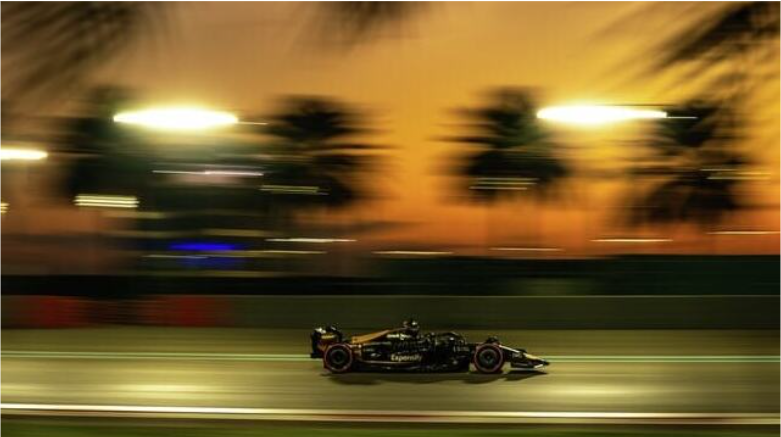
‘F1: The Movie’ follows Sonny Hayes (Brad Pitt), an ex-F1 driver who retired from the sport after a career-ending injury and now races in any series he can, in any car he can, chasing the need for speed. Hayes is brought back to Formula One at the request of Apex GP team owner, Ruben Cervantes (Javier Bardem), who used to be his teammate during his first stint in F1. Hayes is set to drive along with Apex GP’s rookie driver, Joshua Pearce (Damson Idris).
From the get-go, it’s made very evident that Hayes is a one-man team and he only listens to one man: himself, and that he is not above putting himself or others in harm’s way if it gets him that win. We see this perception challenged over the course of the film as Hayes bonds with the Apex GP team, but despite his best efforts, the team struggles to stay afloat.
The Good…
The film does an incredible job of immersing you in the world of racing. During a scene in the third act of the film, Hayes describes the perfect moment of being in the car, one where he feels like he’s flying. You see this feeling play out during the last race of the season, and you truly understand exactly what he was talking about.
Claudio Miranda, the Director of Photography for this film, took the work he and Joseph Kosinski did during Top Gun: Maverick and built on it further. Miranda and Kosinski have worked together multiple times, and Miranda describes their relationship as one where they love to overcome new challenges. With Top Gun: Maverick, that was fitting six cameras into the cockpit of a fighter jet, and with F1, their enemy was weight. To tackle this problem, they fit a Sony FX3 sensor (a very accessible camera) into a camera body, and Panavision built custom remote heads that could be rigged onto the cars, which give us the iconic whip pans during the racing sequences of this film.
… the Bad…
Fans of the sport did receive more than enough warnings from the internet and early reviews to leave the technical brain behind and just enjoy the film for what it is: entertainment. Unfortunately, there were quite a few moments when the suspension of disbelief was thrown entirely out the window. Whether it be as tiny as the F1 race calendar being jumbled around or as large as the Apex GP team dealing with car damage fairly often, as a team on the verge of bankruptcy and liquidation, these errors start to pile on. These details are supposed to act like easter eggs and hype up any fans of the sport watching, and it’s actually a great way to up the stakes if you think about it from a narrative point of view.
Besides the little technical errors, it might not be the best representation of the current era of racing (the early 2010s to now). From a meta perspective, this film is neither fictional nor documentary in nature, with a fictional team made up of characters inserted into the real, current world of F1. Put in the context of racing films as a whole, Cars is an entirely fictional movie with fictional characters. Movies like Rush or Ford v Ferrari, other classics in the list of racing films, while exaggerating historical events for drama, are still built with a foundational truth to them. This film falls smack in the middle of those two. There’s no easy solution to this, of course. They couldn’t have created an entirely new grid filled with fictional characters and teams, and creating a narrative around a current driver would defeat the purpose of this film entirely.
… and the Ugly.
Unfortunately, getting racing wrong isn’t the worst thing this movie does, because its portrayal of women characters is lacking, to say the least. There are 4 female characters in the film – one in a minor role, two in side roles, and one in the main role.
Kate McKenna is the technical director of Apex GP, but has her power almost constantly undermined by Hayes, who asks her to change the entire aerodynamics model of the car. The other two female characters of note are Jodie, a mechanic who’s a part of the pit crew, and Bernadette, Joshua’s mother. Bernadette still feels like a fleshed-out character, one whose point is to illustrate the sacrifices that the families of the drivers have to make. Jodie, however, suffers a fate similar to Kate’s. When we first meet her, she’s seen as a mumbling mess in front of a hot-headed Pearce, and not long after, we see how her mistake costs the team a valuable pitstop.
Taking both Kate and Jodie’s characters together, it feels like this movie goes out of its way to undermine the role of women in the sport, a hot topic in the last couple of years as the sport has gained more popularity. But in 2025, it feels particularly hurtful because of all that women have accomplished in motorsports in the last year alone. From Laura Mueller becoming the first female race engineer for Esteban Ocon of the Moneygram Haas F1 team to F1 Academy gaining massive popularity in its first two seasons, women have come a long way to prove that they belong in motorsports.
Simone Ashley was also announced to be in the film in July 2024, but by the time the film actually premiered less than a year later, her role was cut down significantly. She was set to play Joshua Pearce’s love interest, but the storyline was entirely cut out. When asked about this, Kosinski stated that this is what often happens in movies and that they “shoot a lot more than they can actually use,” while still praising Ashley. This is, however, a larger trend in the industry that people of colour, especially women of colour, have their roles in production severely cut down by the time the final product makes it to our screens.
At the end of the day, F1 is a film built for blockbuster entertainment, and it does that very well. It comes at a lot of costs, especially to the history of the sport and how far it’s come. This isn’t even close to Pitt’s best performance in a sports film (see: Moneyball), and for a fair bit, it comes across as a distant legacy sequel to Tony Scott’s Days of Thunder (which came out on the same day in 1990 as the world premiere of this film). Should you still go and watch this film in theatres? Absolutely! And if you so wish, become a fan of the sport itself and immerse yourself in the very rich, often very funny, often quite scandalous world of Formula One.