Author: Tanisha Dassani

  • Centre Court’s New Classic: A Tale of Fire and Ice

    Centre Court’s New Classic: A Tale of Fire and Ice

    Muhammad Ali versus Joe Frazier, Manchester United versus Liverpool, the Boston Celtics versus the Los Angeles Lakers, Lin Dan and Lee Chong Wei: Sport thrives on rivalries. Audiences become fans of an athlete’s skill, personality, and consistency, and through that connection find a greater thrill in the game itself. Rivalries bring these audiences together, turning their support into fuel for a sport’s growth. Throughout history, these contests have revolutionised sports, and tennis has been fortunate enough to host many.

    In men’s singles Tennis, multiple rivalries have defined eras, like Borg-McEnroe and Sampras-Agassi, but the most impactful of them all was between Roger Federer and Rafael Nadal. Federer was an elegant powerhouse famous for his effortless game and remarkable single-handed backhand, while Nadal was the “King of Clay”, owing to his high-spinning forehand and near-perfect record on clay. Along with Novak Djokovic, they ruled men’s tennis for nearly two decades. Yet, the Federer-Nadal pairing remained special, built on a foundation of mutual respect and genuine friendship. With Federer’s retirement in 2022 and Nadal’s farewell tour in 2024, the spot for the next big rivalry in tennis was open for contention, and two young stars have quickly taken over.

    First, meet Jannik Sinner. Born in San Candido, Italy, the 24-year-old rose to the top of the men’s standings, achieving the World Number One rank in 2024 after his first Grand Slam win at the Australian Open. Leaving his home at just fourteen to train full-time, he began his development under renowned coach Riccardo Piatti, a mentor to talents like Novak Djokovic and Richard Gasquet. Sinner announced his arrival on the ATP tour in 2019 by winning the Next Gen ATP Finals in Milan. The following year, at age 19, he became the youngest Italian in the Open Era to win an ATP title. Driven by early financial strains, he recently revealed that he had promised his parents he would quit tennis if he wasn’t in the top 200 by age 24. Today, with four Grand Slams and 21 ATP titles to his name, it is safe to say he has surpassed his own expectations.

    Next is Carlos Alcaraz, a 22-year-old Spaniard and the current World Number One. Characterised by his innate talent and aggressive playstyle, Alcaraz has a natural feel for the game. At fifteen, he began his journey under the guidance of fellow Spaniard and former world number one Juan Carlos Ferrero, turning pro a year later at sixteen. A true tennis prodigy, Alcaraz became the youngest male player in history to reach the No. 1 ranking at 19 years of age, following his first major win at the 2022 US Open. Since then, he has acquired five more majors along with 23 ATP titles, and with his young age, this is only the beginning.

    This year, Sinner and Alcaraz have duelled numerous times and their rivalry has electrified the sport. Their first meeting of the season was in the final of the Italian Open, Sinner’s first tournament after facing a three-month ban due to doping. At his home tournament, Sinner played a close match, but ultimately Alcaraz emerged victorious with a scoreline of 7-6(7-5), 6-1. But this was just a teaser for what was coming next.

    At the French Open, Sinner managed to set another final against Alcaraz, where the two made history by playing one of the most extraordinary matches of the decade. Alcaraz made a show-worthy comeback, saving three match points to beat Sinner 4-6, 6-7 (4), 6-4, 7-6 (3), 7-6 (10-2) in the longest French Open final ever at 5 hours and 30 minutes, winning his second consecutive Roland Garros title. Alcaraz also ended Sinner’s unbeaten record at Grand Slam finals, while he protected his own winning streak. The story continued at Wimbledon, the two meeting yet again in the final. Yet this time, Sinner turned the tables and handed Alcaraz, the two-time defending champion, his first loss at a major final 4-6, 6 4, 6-4, 6-4. It was Sinner’s second Slam of the year, winning the Australian Open earlier in January after defeating Alexander Zverev.

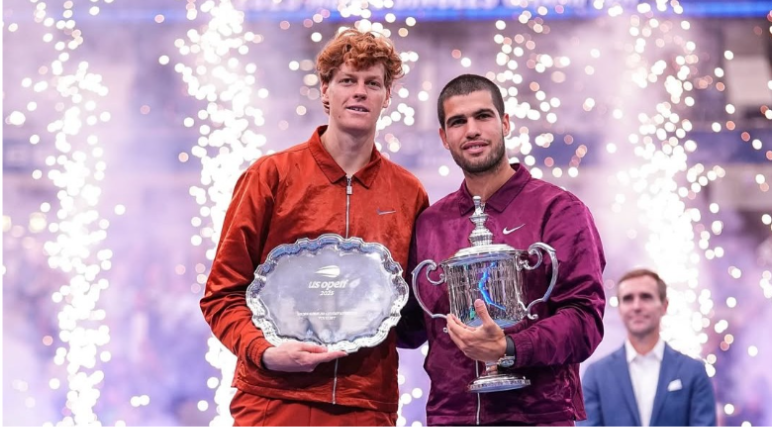
    The recent US Open was filled with the likes of Novak Djokovic, Ben Shelton, Taylor Fritz and Lorenzo Musetti providing much more competition, yet for the third consecutive time Sinner and Alcaraz faced off in a Major final. Alcaraz ended the Italian’s streak of 27 slam wins on hard courts to take the title, and in the process splitting the four grand slams between them for two straight years. Alcaraz also dethroned Sinner as the World Number One, ending his 65-week reign at the top.

    These matches are early signs of a brewing rivalry that has the potential to sustain itself for years to come. A year of 5 finals and counting, they have shown a remarkable hold over the ATP tour, nobody else being able to match them in Slams. While Sinner is the more calculated player, grinding down his opponents with immaculate defence and consistent baseline strokes, Alcaraz is extremely aggressive with a variable playstyle, incorporating drop shots and a great net presence into his arsenal. As Sinner himself alluded, Alcaraz brings the “firepower and hot shots,” while he provides the composure of a relentlessly solid player. What more could we ask for? Perhaps the dawn of the next Big rivalry in the sport.
  • Are Superhero Movies Still Landing?

    Are Superhero Movies Still Landing?

    The Marvel Cinematic Universe’s (MCU) long-awaited Phase 6 kicks off this month with Fantastic Four: First  Steps. Like most of Marvel’s recent movies, Fantastic Four: First Steps also features a star-studded cast, which includes Pedro Pascal, Vanessa Kirby, Joseph Quinn, and Ebon Moss-Bachrach. The film is directed by Matt Shakman, a Marvel veteran, who previously directed Marvel’s WandaVision in 2021. Based on pre-ticket sales, the movie is predicted to earn massively at the box office. Despite this initial hype with pre-ticket sales numbers, previous Marvel projects point to a disconnect between their ambitious output and audience engagement, begging the question: Are we still as excited for big Marvel projects as we used to be?

    Dwindling anticipation is not limited to recent projects, as it affected the entirety of Marvel’s last phase, Phase 5, which came to be the MCU’s least successful phase in terms of revenue generated. Superhero fatigue is real, there’s no denying it, but certain box office successes make a case for the genre being an indispensable part of cinema that generates substantial viewership without sacrificing the craft of filmmaking. Like Guardians of the Galaxy Vol. 3, which was a remarkable attempt at exploring one of the MCU’s wittiest characters, Rocket, while successfully developing a dynamic group of characters and their stories.

    A few key reasons explain this decline in enthusiasm, particularly the challenge of keeping up with so many interconnected stories, complicated further by the dual system of series and movies. While it was smart to diversify into shows to adapt to the new OTT environment, the decision also hampered the complex Marvel plotline experience because audiences cannot keep up anymore.  Central to MCU’s brand is the seamless connection of different plotlines over time, but ease of continuity in viewers’ minds is essential for this to work. However, now, there are too many shows to consume, with most getting left behind in the “continue watching” sections of our OTT accounts. The sheer anxiety of consuming the massive volume of content in the Cinematic Universe makes it difficult for audiences to appreciate it.

    Shows allow characters to develop over multiple seasons, so when we transition back to a three-hour movie, the character journeys seem substantially less impactful. Remember Eternals? They were a group of ten superheroes that the MCU introduced back in 2021 with the expectation that audiences would root for them for approximately two and a half hours, only to leave them abandoned.

    The problem with character-building is also evident in instances like Yelena Belova’s character, played by Florence Pugh, who is now leading the ‘New Avengers’ (Thunderbolts*). Unlike her sister, Black Widow, who audiences came to adore even before she had a standalone movie, Yelena’s character was tossed around in a series with Hawkeye and the Black Widow movie, and then suddenly handed the baton to be the next leader.

    Established actors and big names now leading Marvel stories highlight a growing misstep for the franchise. The appeal of earlier characters like Captain America and Thor stemmed mainly from the fact that the actors portraying them were relatively fresh faces, stepping into their roles with almost a clean slate. These allowed the audiences to define the actors by their MCU roles.

    Today, however, stars like Florence Pugh, known for her role in the Dune series; Kit Harington, famous as Jon Snow; David Harbour, a fan-favourite from Stranger Things; and Pedro Pascal, who has become a pop-culture icon and phenomenon, headline Marvel projects. Marvel even brought back Wolverine, played by Hugh Jackman, so that the new Deadpool movie could primarily be not a cinematic success, but a marketing one. Marvel, which was once known for launching actors with unforgettable roles, is now feeding off actors’ stardom to fill theatres. Whether this reliance will pay off remains unclear, as viewers continue to find it challenging to dissociate characters from the actors playing them.

    Marvel’s plotlines have been subject to criticism, particularly for their generic protagonist-turned-villain theme, milked repeatedly with characters like Scarlet Witch in Doctor Strange in the Multiverse of Madness, Hulk in Avengers: Age of Ultron, and Bucky Barnes in Captain  America: The Winter Soldier. In their defence, the infinite number of superhero movies released every year outside the MCU makes it increasingly difficult to stay original.

    In terms of originality, looking beyond the MCU helps put things in perspective, as a lot can still be done to keep the genre fresh. For instance, Everything Everywhere All at  Once was a unique take on the previously explored metaphor of mothers as superheroes. The animated movie series The Incredibles remains highly entertaining, even though a similar concept was previously explored in Fantastic Four. Moreover, classics like The Dark  Knight trilogy continue to be loved because the movies explore real-world themes using their heroes and villains as funnels to make arguments, and not the other way around. Watching the three Spider-Men reunite was undeniably entertaining, but do we really need Robert Downey Jr. to return as a supervillain?

    Inclusivity and diversity, as demonstrated by the success of Black Panther, have been positive additions to the Marvel universe. However, does representation need to be as overt as seen in Ms. Marvel? Taika Waititi’s Thor: Ragnarok executed comedy brilliantly, but should Deadpool & Wolverine have relied so heavily on humour that the movie felt more like a 2-hour-long stand-up routine? The Marvel Cinematic Universe continues to grow, and its budgets, audiences, and VFX capabilities grow with it. They just need to be more selective and certain about the stories they choose to tell. How they tackle this will determine if the next phase sticks the landing.