Author: Sneha

  • Beyond the Myth: The Living Power of the Maha Kumbh

    Beyond the Myth: The Living Power of the Maha Kumbh

    Life is filled with curves and circles, looping through birth, death, and rebirth. Each soul is affected by karma and longs for release, Moksha. In this journey for liberation, only once every 144 years comes a moment when the heavens align. This moment is the Maha Kumbh Mela, a spiritual phenomenon where millions gather to cleanse their sins, dissolve their egos, and connect with something far greater than themselves.

    At the heart of this divine convergence is Triveni Sangam in Prayagraj, the sacred convergence of the Ganga, Yamuna, and Saraswati. According to ancient scriptures, this Sangam is not just a sacred place where these rivers meet, but it is a doorway to spiritual awakening. A dip in these holy waters during the Maha Kumbh is said to wash away lifetimes of accumulated karma, breaking away from the very cycle of life and death.

    When the Sun, Moon and Jupiter align, it is believed the rivers become charged with Amrit, the divine nectar of immortality. There existed a time when the universe itself was in a state of instability. The Devas (gods) and Asuras (demons) joined forces to churn the cosmic ocean in pursuit of Amrit. As the pot of Amrit emerged, chaos unfolded. To protect it from falling into the wrong hands, Lord Vishnu, in the form of Mohini, whisked it away. In the celestial fight that followed, four drops of Amrit fell on Earth, Prayagraj, Haridwar, Ujjain, and Nashik. These four cities became sites of sacred convergence. And thus, the Kumbh Mela was born.

    “In the eternal churn of the cosmos, gods and demons wrestled not for gold or land, but for a drop of immortality.”

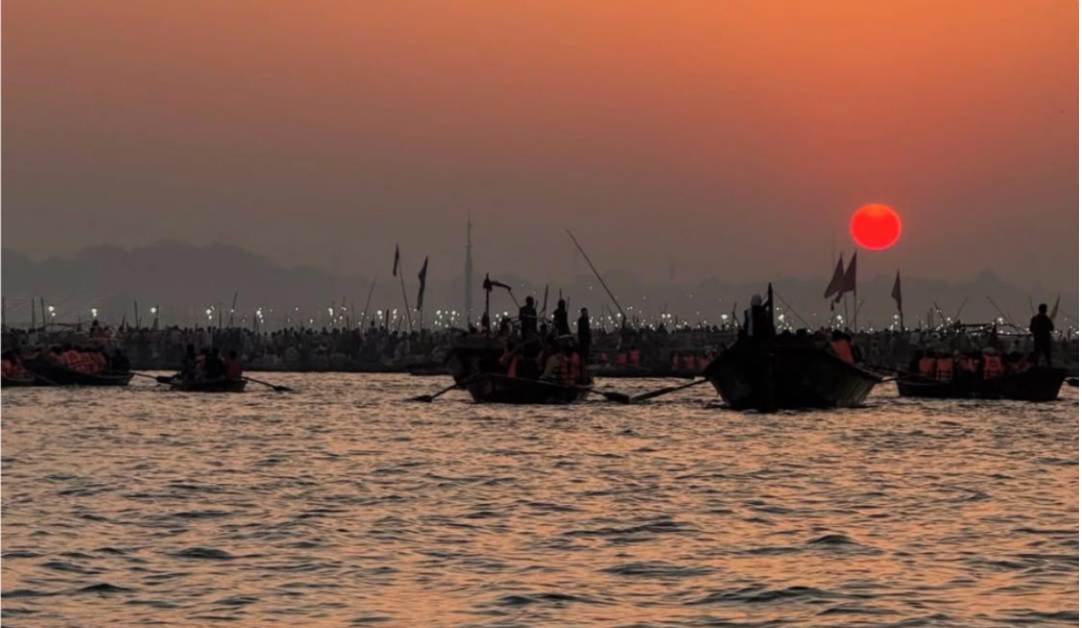
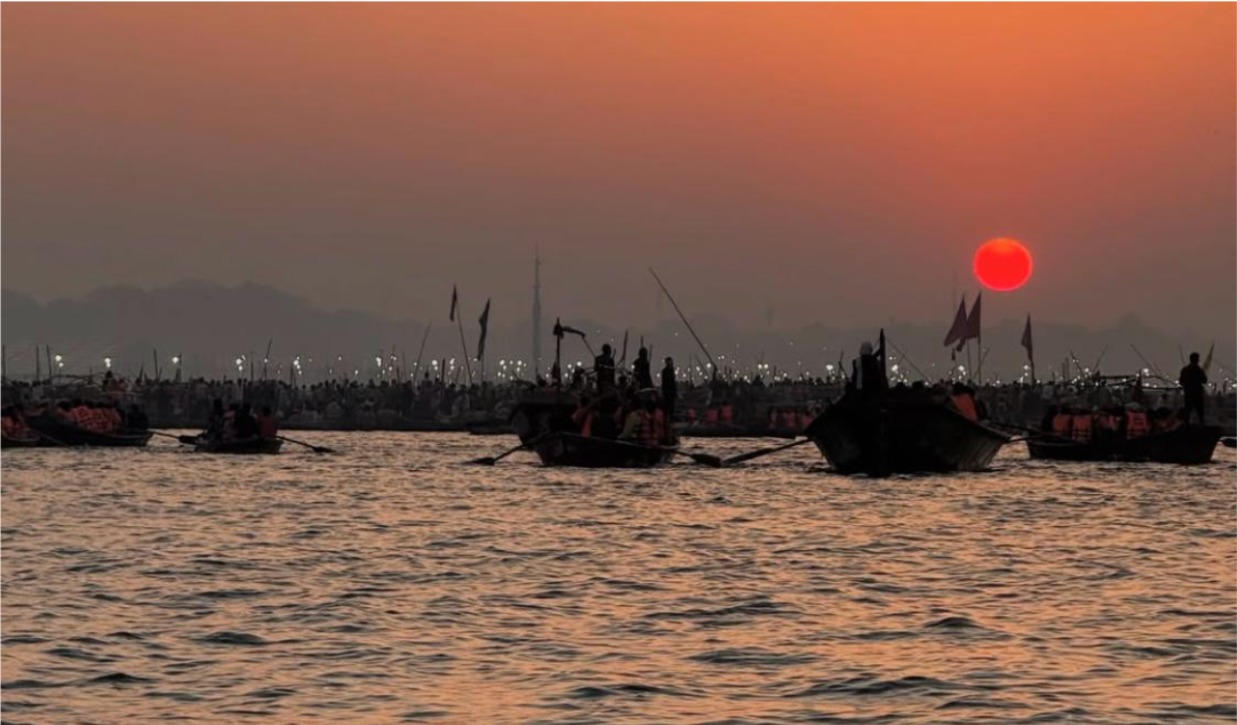
    But the Maha Kumbh is not just about myths. It is also a breathtaking display of humanity. Over 400 million people visited from all corners of the world, rich and poor, saints and sceptics, to participate in this unfathomably vast gathering. Temporary cities rise on the riverbanks, complete with roads, clinics, tents, and sanitation, all for a few sacred weeks. The air hums with chants, conch shells, and the scent of incense, forming a sensory experience unlike any other.

    Leading the way into the waters are the Naga Sadhus, warriors devoted to Lord Shiva. Covered in ash, with matted hair and tridents in hand, they march nude and unbothered, a living challenge to the materialistic world. For many pilgrims, witnessing the Nagas is as transformative as the dip itself.

    And then there is the spirit of seva, selfless service. Bhandaras, or community kitchens, are set up on every lane of the city. Here, everyone eats for free. Volunteers, often anonymous and unpaid, serve hot meals from sunrise to nightfall. There is no caste, no status, only humanity sharing a meal together. It is extraordinary kindness on a massive scale, showing that devotion does not just lie in prayer, but in action.

    The Maha Kumbh Mela might appear, at first glance, like overwhelming chaos – crowds of people surging into muddy rivers, noise echoing in every direction, giving one no space to breathe. Yet, for those who stand on the riverbank, it becomes something else entirely. It feels like everything has a purpose, as if there is a deeper meaning beneath the surface.

    When you step into those cold waters, you are not just taking a bath. You’re letting go of stress, guilt, regret, or even ego. You’re washing off layers of your past. And in that moment, as the river flows around you, you don’t just feel clean, you feel light, open, and somehow… free.

    Image Source: Official Instagram Handle/ @mahakumbh_25
  • A Journey through Chettinad Heritage and Craftsmanship

    A Journey through Chettinad Heritage and Craftsmanship

    Legend has it that within the walls of the mansions of Karaikudi lie hidden treasures, carefully concealed by the wealthy Chettiars to protect their fortunes from invaders. Rumours of ghostly apparitions drifting through the corridors only add to the intrigue as residents and visitors share stories of eerie encounters and unexplained phenomena. But it’s not just the supernatural that lurks within the walls of these opulent homes. Behind the façade of wealth and splendour lies a darker history of family feuds and betrayals. Sibling rivalries, clandestine affairs, and secret alliances are whispered in hushed tones, their echoes reverberating through the halls. Yet amidst the tales of curses and hexes, there is also a sense of awe and wonder at the architectural marvels that testify to the craftsmanship and ingenuity of the Chettiar builders. Each mansion tells its own story through its unique blend of indigenous and colonial styles, its hidden symbols and motifs hinting at mysteries yet to be unravelled.

    Initially a part of the Pandiyan Dynastry and later under the rule of various dynasties such as the Cholas, Cheras and Pallavas, Karaikudi is tied to the Nattukottai Chettiar community. The Chettiars were renowned for their business astuteness, engaging in trade and banking across Southeast Asia. They established a network of businesses, bringing wealth and prosperity to Karaikudi and the surrounding areas.

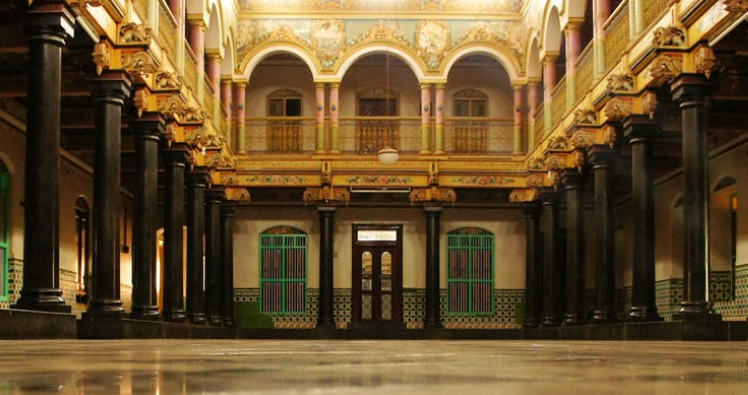
    The profuse mansions of Chettinad stand as a testament to the region’s prosperous past and architectural prowess. At first, these houses might seem compact from the outside; however, hidden behind the exterior walls are spacious inner courtyards adorned with luxurious Burmese teak furnishings and majestic Italian marble columns. Beneath your feet lie the Athangudi tiles, whispering tales of a past long gone. The spaces above the window frames are adorned with miniature paintings of everything ranging from different flowers and patterns to even paintings of gods and goddesses.

    Each mansion is a work of art, reflecting a unique blend of indigenous and colonial influences. These architectural marvels offer a glimpse into Chettinad’s illustrious history and cultural heritage. The Atthangudi Palace in Karaikudi stands tall to attest to the region’s rich cultural heritage. This magnificent palace is a sight and portal to the past, beckoning visitors to step back in time and experience the grandeur of a bygone era. A personal visit to Karaikudi exposed me to these architectural marvels. I vividly remember a younger version of me staring up at the tall ceiling, the geometric tile pattern below and the timeless elegance of the window and its paintings.

    The Athangudi tiles felt so perfect yet simple at the same time. Witnessing the tile-making process, one will realise why they are popular and how sustainable they are, making them stand out. First, the glass base is placed on a foundation, followed by the outer frame and a brass pattern mould. Colours are poured into the design grill according to the desired pattern, and after laying the colour layer, a dry mixture of sand and cement is spread on top, and then the mould is filled with wet mortar. The tile is left to dry, soaked in water, and dried again before removing the glass and sanding the edges. This process makes these tiles economically affordable, sustainable, and durable, representing a blend of tradition and modernity without the need for firing or electricity during manufacturing.

    The spiritual wealth of Karaikudi is not to be underestimated either. With each clan having their respective temples built, only nine clan temples are considered the most auspicious and are also known as the ‘Nine Temples of Chettiars’. The Karpaka Vinayakar Temple, popularly known as the Pillayarpatti Temple, dedicated to Lord Ganesha, is a revered temple 12 km from Karaikudi. It is well-known for its magnificent rock-cut images of Ganesha, Siva linga, and other splendid carvings. The temple’s history dates back to the 7th century, with some parts possibly even older. The temple has a colourful gopuram, intricately designed mandapams, and shrines that follow Agamic texts and Shilpa Sastras, still attracting devotees, particularly

    women during annual festivals and chariot processions like Vinayaka Chaturthi and Brahmothsavam in Vaikasi month.

    During my stay at the Bangla and Heritage Resort, I took a cooking class and watched the chefs expertly prepare local Chettinad dishes, and it became evident why this cuisine is so beloved. What sets Chettinad cuisine apart is its masterful use of freshly ground masalas, incorporating a blend of spices like fenugreek, star anise, and peppercorns. Combined with onions, tomatoes, coconut, and aromatic herbs, these masalas transform regional dishes into gastronomic delights. Chettinad cuisine is particularly renowned for its non-vegetarian offerings, including Nattukozhi Kozhambu (country chicken), Aatukari Kozhambu (lamb), and Karaikudi Eral (prawn) masala. These dishes are commonly enjoyed alongside staples like idli, dosa, parotta, and appam, enhancing their flavours and elevating the dining experience.

    Photo Credits: A Chettinad House in Karaikudi /Poornima Narayan

  • Tearing down Walls: The Symbolism and Impact of the Berlin Wall

    Tearing down Walls: The Symbolism and Impact of the Berlin Wall

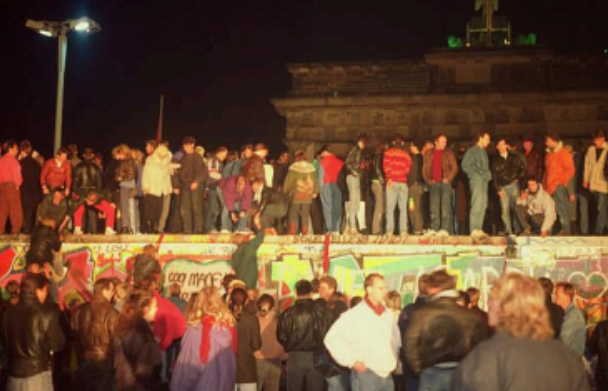
    Walls have a unique way of telling stories. Some are built to protect, others to divide. The Berlin Wall was one of the most infamous barriers in history, a concrete reminder of the ideological conflict that once split the world in two. But it wasn’t just about physical separation; the Berlin Wall stood as a powerful symbol of oppression, control, and the lengths to which a regime would go to maintain power. Its fall in 1989 wasn’t just a relief for Berliners; it became a beacon of hope for the world.

    So, why was this wall built, and why does its fall continue to resonate with us today?

    After World War II, Germany was divided into four zones controlled by the Allies: the United States, the Soviet Union, Britain, and France. Berlin, though deep within the Soviet-controlled zone, was split similarly. The Western part of the city flourished under democracy and capitalism, while the East fell under the iron grip of Soviet communism. This led to a significant contrast in living conditions, and by the late 1950s, East Germans were fleeing to West Berlin, seeking freedom and better opportunities.

    On 13 August 1961, the German Democratic Republic (GDR) sealed the border. Berliners on both sides watched in shock as barbed wire fences went up, soon replaced by concrete, steel, and watchtowers. In a matter of hours, families, neighbours, and friends were torn apart. What had been a single city now felt like two different worlds.

    This wall wasn’t just bricks and mortar but a painful reminder of the ideological battle between East and West. The Berlin Wall quickly became the physical embodiment of the Cold War, a war fought not with guns and tanks but with ideas, policies, and propaganda. On one side stood the promise of freedom and opportunity; on the other, oppression and control.

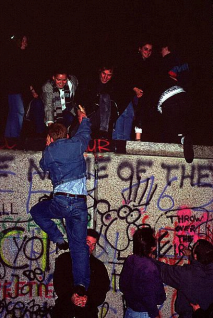
    For East Germans, the Wall became a prison. It represented everything they were denied: freedom to travel, freedom of speech, freedom to live the life they wanted. Trying to cross the Wall meant risking your life. Over 140 people were killed while attempting to escape. Their desperate actions were a testament to how unbearable life behind the Wall could be. Yet, for the people of West Berlin, the Wall became a canvas. The grim, grey concrete on the Western side was soon covered with graffiti, murals, and messages of hope, defiance, and protest. While East Berliners saw only the cold reality of their confinement, West Berliners used the Wall to express their belief in freedom, resistance, and the fight for a better future. By 1989, the gaps in the Eastern Bloc were starting to show. Across Eastern Europe, people were demanding change. Protests spread, and the calls for freedom grew louder in East Germany. The pivotal moment came during a routine press conference on the evening of November 9, 1989. Günter Schabowski, a senior official in the East German government, was tasked with announcing new travel regulations that would ease the movement of East Germans to the West. However, there was one problem: Schabowski had not been fully briefed on the details.


    Photo Credits: Roland Blunck/ IStock Photo
    Holding a piece of paper that outlined the new policy, Schabowski read aloud that East Germans would be allowed to apply for visas to travel abroad “without meeting the usual conditions.” The plan was for these changes to take effect the next day, allowing the government time to prepare and manage the flow of people.

    But then, a journalist in the audience asked a crucial question: “When does this take effect?” Schabowski, clearly flustered and unsure, glanced at his notes and muttered, “As far as I know, it takes effect immediately, without delay.”

    Those words triggered a chain reaction, sending thousands of East Berliners rushing to the border crossings. Overwhelmed and confused, the guards, who hadn’t been briefed on handling the situation, decided to let people through. This unexpected decision led to the joyous scenes of Berliners tearing down the Wall, symbolising the collapse of the Cold War’s most iconic barrier.

    The fall of the Berlin Wall was more than just the end of a physical divide; it marked the collapse of an ideological wall that had kept people apart for nearly 30 years. Its sudden, almost accidental dismantling became a symbol of human resilience, the triumph of freedom over oppression, and the power of unity. The Wall may have stood as a stark reminder of what can happen when division is allowed to reign, but its fall became a beacon of hope, showing the world that no matter how strong the barriers seem, they can be torn down.

    After the Berlin Wall was dismantled in 1989, pieces of it were distributed around the world as symbols of freedom and unity. Notable locations include the East Side Gallery and Berlin Wall Memorial in Berlin and the Wall Along Wilshire in Los Angeles, which is the longest segment outside Germany. Other pieces are displayed at the Imperial War Museum in London, the Vatican Gardens, the War Memorial of Korea in Seoul, Nelson Mandela Square in Johannesburg, Europapark in Madrid, and outside the United Nations Headquarters in New York City. These pieces continue to remind us of the triumph of freedom over division.

    A piece of the Berlin Wall is located in an unusual place: a men’s restroom in Las Vegas. Specifically, it can be found at the Main Street Station Hotel and Casino. The wall fragment is installed behind glass in the bathroom. This quirky and unexpected display has become a tourist attraction, allowing visitors to view and touch a piece of history in one of the most unlikely settings.

  • After Nearly a Century, HUL Gets Its First Female Chief

    After Nearly a Century, HUL Gets Its First Female Chief

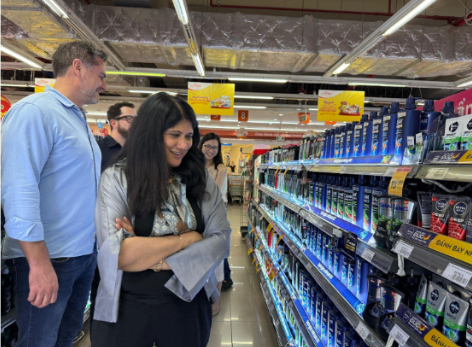
    For the first time in its 92-year history, Hindustan Unilever Limited (HUL) will be led by a woman. Priya Nair has been appointed as the new CEO and Managing Director of HUL, and will be taking over from Rohit Jawa on August 1st, 2025.

    Priya Nair isn’t new to HUL. She has worked for the company for almost 30 years, starting in sales and marketing and steadily climbing the ladder, proving herself every step of the way. She is currently the President of the beauty and wellbeing sector at Unilever, where she led iconic campaigns for brands like Dove, Rin and Comfort. She is also known for creating stories that connect with people, especially women and families, and her in-depth understanding of the Indian market made her one of the most respected marketers in the industry.

    But this move is more than just a change in the job title. It highlights the slow pace of change in the Indian boardrooms. HUL, a household name with products in nearly every Indian home, had never had a female CEO for almost a century, and Nair’s appointment is a clear sign that leadership is finally becoming more inclusive.

    She brings to the table not just experience, but also empathy. Her leadership style is expected to focus on people, sustainability, and innovation. As consumer habits change, especially post-pandemic, HUL will need fresh ideas to stay relevant. Her track record shows she understands this shift. She led campaigns that didn’t just sell soap or shampoo; they told stories that made people feel seen and heard.

    Her promotion also sends a message to young women across the country – the top seat is within reach. Even in industries where men have always held power, things are changing. It’s a reminder that talent, vision, and consistency can break barriers,  even those built over nine decades.

    HUL is India’s biggest fast-moving consumer goods (FMCG) company. It sells everything from tea and detergent to skincare and health products. With over 50 brands in its portfolio and a presence in every part of the country, leading HUL is no small task. But Nair is seen as someone ready for the challenge.

  • HYBE CEO Steps Down Amid BTS Comeback and India Expansion

    HYBE CEO Steps Down Amid BTS Comeback and India Expansion

    Scooter Braun Steps Down: HYBE’s Bold New Era Begins

    In a surprising move, Scooter Braun has stepped down as CEO of HYBE America. Braun, known for managing global stars like Justin Bieber and Ariana Grande, had joined HYBE in 2021 when the South Korean entertainment giant acquired his company Ithaca Holdings for around $1 billion. For years, he played a key role in helping HYBE expand into the American market, leading big-name signings and industry takeovers, including the $300 million acquisition of Quality Control Music. However, as of 1 July 2025, his leadership era has officially ended.

    The timing feels far from random. HYBE insists this transition was planned since the 2021 deal. Braun isn’t completely stepping down though; he will continue as a board member and strategic advisor to HYBE founder Bang Si-hyuk. Isaac Lee, previously heading HYBE’s Latin American operations, has stepped in as the new CEO of HYBE America.

    Braun’s exit has been met with mixed reactions. While his industry connections helped HYBE grow globally, he’s also been a controversial figure, especially after his public feud with Taylor Swift over the ownership of her early music. Many BTS fans, who had long been uneasy about Braun’s influence on HYBE, saw his exit as a “cleansing moment.” In fact, Braun stepping down just hours after BTS reunited online has sparked speculation that this was a calculated reset.

    BTS Is Back: The Comeback Fans Were Dying For

    On the same day, Braun stepped aside, and BTS came together for a surprise livestream on Weverse. All seven members appeared together on screen for the first time in nearly two years, sending ARMYs worldwide into meltdown. The band is officially back from their military service, and they’re already planning their comeback album and tour.

    During the livestream, BTS confirmed that they’ll start working on new music in July 2025 and aim to release a full album by spring 2026. This would be their first full-length group album since “Proof” in 2022. Even more exciting is a world tour planned for the same year. With their military duties now complete, all seven members- Jin, RM, SUGA, j-hope, Jimin, V, and Jungkook- are finally coming back together.

    This comeback means more than just new songs- it marks the return of the most powerful K-pop band of all time. And BTS isn’t just a band; they’re a cultural force. They’ve spoken at the United Nations, topped global charts, and built an army of fans stretching across continents. Their return instantly shifts the entire music industry. It also gives HYBE a significant advantage as it prepares for its next phase of global expansion.

    HYBE Heads to India: A New Chapter Begins 

    HYBE is officially entering India. With its massive population, youthful demographic, and growing love for Korean entertainment, India is a dream market for any entertainment company. HYBE recognised this potential and announced plans to open a full-fledged Indian subsidiary in the second half of 2025.

    The new office is expected to launch around September or October and will likely be based in Mumbai. Preparations have already begun, with research teams surveying the local music market. The company sees India as a core market for developing new artists and bringing K-pop closer to South Asian fans.

    Instead of pushing Korean acts globally, they want to build locally relevant entertainment hubs in major regions like the U.S., Japan, Latin America, and India. It’s not just about bringing BTS and SEVENTEEN to new countries, but about creating Indian stars through the same system that made K-pop what it is today.

    What This Means for Fans 

    For Indian fans, this is a huge deal. HYB’s presence in India allows concerts, exclusive events, official auditions, and local artist development. There’s already a buzz around HYBE’s ‘Cine-Fest’, which will screen BTS and other K-pop concert films in Indian theatres from 10 July to 13 July 2025. This could be regarded as the company testing the waters before launching larger fan engagement events.

    And, of course, all eyes are on whether BTS will finally have concerts in India in 2026. The idea doesn’t seem far-fetched anymore. During his solo promotions, j-hope hinted that India might be added to future tour maps, especially once HYBE formally sets up its office in the country. For millions of Indian ARMYs, that’s a dream come true.

  • Beyond the Myth: The Living Power of the Maha Kumbh

    Beyond the Myth: The Living Power of the Maha Kumbh

    Life is filled with curves and circles, looping through birth, death, and rebirth. Each soul is affected by karma and longs for release, Moksha. In this journey for liberation, only once every 144 years comes a moment when the heavens align. This moment is the Maha Kumbh Mela, a spiritual phenomenon where millions gather to cleanse their sins, dissolve their egos, and connect with something far greater than themselves.

    At the heart of this divine convergence is Triveni Sangam in Prayagraj, the sacred convergence of the Ganga, Yamuna, and Saraswati. According to ancient scriptures, this Sangam is not just a sacred place where these rivers meet, but it is a doorway to spiritual awakening. A dip in these holy waters during the Maha Kumbh is said to wash away lifetimes of accumulated karma, breaking away from the very cycle of life and death.

    When the Sun, Moon and Jupiter align, it is believed the rivers become charged with Amrit, the divine nectar of immortality. There existed a time when the universe itself was in a state of instability. The Devas (gods) and Asuras (demons) joined forces to churn the cosmic ocean in pursuit of Amrit. As the pot of Amrit emerged, chaos unfolded. To protect it from falling into the wrong hands, Lord Vishnu, in the form of Mohini, whisked it away. In the celestial fight that followed, four drops of Amrit fell on Earth, Prayagraj, Haridwar, Ujjain, and Nashik. These four cities became sites of sacred convergence. And thus, the Kumbh Mela was born.

    “In the eternal churn of the cosmos, gods and demons wrestled not for gold or land, but for a drop of immortality.”

    But the Maha Kumbh is not just about myths. It is also a breathtaking display of humanity. Over 400 million people visited from all corners of the world, rich and poor, saints and sceptics, to participate in this unfathomably vast gathering. Temporary cities rise on the riverbanks, complete with roads, clinics, tents, and sanitation, all for a few sacred weeks. The air hums with chants, conch shells, and the scent of incense, forming a sensory experience unlike any other.

    Leading the way into the waters are the Naga Sadhus, warriors devoted to Lord Shiva. Covered in ash, with matted hair and tridents in hand, they march nude and unbothered, a living challenge to the materialistic world. For many pilgrims, witnessing the Nagas is as transformative as the dip itself.

    And then there is the spirit of seva, selfless service. Bhandaras, or community kitchens, are set up on every lane of the city. Here, everyone eats for free. Volunteers, often anonymous and unpaid, serve hot meals from sunrise to nightfall. There is no caste, no status, only humanity sharing a meal together. It is extraordinary kindness on a massive scale, showing that devotion does not just lie in prayer, but in action.

    The Maha Kumbh Mela might appear, at first glance, like overwhelming chaos – crowds of people surging into muddy rivers, noise echoing in every direction, giving one no space to breathe. Yet, for those who stand on the riverbank, it becomes something else entirely. It feels like everything has a purpose, as if there is a deeper meaning beneath the surface.

    When you step into those cold waters, you are not just taking a bath. You’re letting go of stress, guilt, regret, or even ego. You’re washing off layers of your past. And in that moment, as the river flows around you, you don’t just feel clean, you feel light, open, and somehow… free.