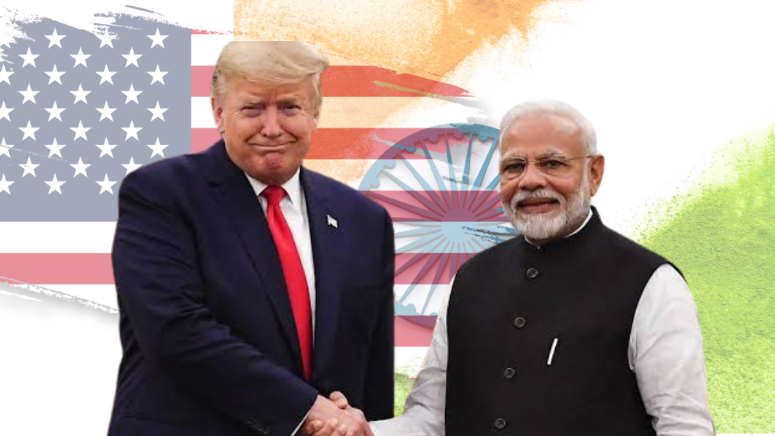
On 6 August 2025, President Donald J. Trump signed an executive order that imposes an additional tariff of 25% on imports from India, effectively pushing the headline U.S. tariff on many Indian goods to 50% where the earlier reciprocal rate also applies.
The implementation is not uniform, with the US administration signalling targeted applications. Some products appear to be exempted (for example, some smartphone and pharmaceutical shipments), but for labour-intensive categories where Indian exporters are concentrated- apparel, gems & jewellery, carpets and some food items- the tariff rate can become a threat very quickly, as buyers can likely shift suppliers.
The order says the additional duty is being imposed because the U.S. government finds India is “directly or indirectly importing Russian Federation oil” and that the step is needed to address “an unusual and extraordinary threat” to U.S. national security. Unless India concedes in the next three weeks, the move will potentially hit its single largest export market, worth $87.3 billion annually.
Indian Energy Security Meets America First
Before the Ukraine war, Russian oil was barely 2% of India’s imports. However, by 2024, it had increased to 36%. In the first half of 2025, imports hit 1.75 million barrels daily. The rationale for India has been straightforward- cheap oil for a country of 1.4 billion is an economic necessity, not a geopolitical endorsement.
Trump sees it differently. “India has always bought a vast majority of their military equipment from Russia, and is Russia’s largest buyer of energy,” he wrote on social media. “They can take their dead economies down together.” It’s the second tariff hike, which has been framed as retaliation for India’s ‘funding’ of Moscow’s war machine.
New Delhi has pushed back hard, accusing Washington of hypocrisy. The Ministry of External Affairs has pointed out that the EU’s trade with Russia last year- 67.5 billion euros in goods and 17.2 billion euros in services, far exceeded India’s. And the U.S. continues to tolerate large Russian energy purchases by China and Turkey without resorting to similar penalties. “Our imports are based on market factors and energy security needs,” the ministry said, calling the tariffs “unfair, unjustified, and unreasonable.”
Prime Minister Narendra Modi’s recent phone call with Russian President Vladimir Putin about an upcoming visit did nothing to dismiss Trump’s idea of India as a Moscow enabler.
Trump’s Real Obsession- The Trade Deficit
For all the moral high ground Trump’s taking on Russia, many economists believe the real reason is the U.S.’s goods trade deficit with India. In 2024, as per a Reuters report, the gap widened to $45.8 billion, up 5.1% year-on-year. India’s exports to the U.S., led by pharmaceuticals, textiles, gems, and machinery, hit $87.3 billion, while U.S. exports to India lagged at $41.5 billion. May 2025 alone saw $8.83 billion worth of Indian goods heading to America.
Trump has long viewed this imbalance as proof of Indian protectionism. His “reciprocal trade” doctrine demands zero-deficit commerce- a fantasy in the real world, but one he has applied indiscriminately, from Canada (35% tariffs) to Mexico (25%) and even close allies like the UK and Australia. The Russia issue, analysts argue, is a convenient pretext for a tariff tactic that forces India to buy more American oil, defence hardware, and agricultural goods.
If the tariffs stick, U.S. consumers will inevitably pay more for everything from T-shirts to generic medicines. However, for Trump, the possibility of a narrowed deficit balances the domestic inflation risk.
Economy and Market- Two Peas in a Pod
Citigroup warns of a 0.6% to 0.8% GDP hit for India if the tariffs endure; Morgan Stanley agrees on the upper bound. A more optimistic PHDCCI report estimates the damage to be just 0.19% of GDP, affecting less than 2% of exports. Either way, the pain will be sector-specific. Labour-intensive industries like textiles, gems, and pharmaceuticals will feel the brunt first. Supply chains may shift to Bangladesh or Vietnam, recreating what had happened when U.S.-China tariffs shifted manufacturing flows. The Reserve Bank of India has already intervened to limit rupee weakness.
However, if Trump expected the Indian markets to report a major fall, the response has been underwhelming. The BSE Sensex closed at 79,857.79 on 8 August, down just 0.95%, with the Nifty 50 matching the fall. The losses marked a sixth straight week in the red- the longest such streak in five years, but why is panicking unnecessary?
Foreign institutional investors pulled ₹15,950 crore from Indian equities in early August, but domestic institutional investors more than offset this with ₹29,070 crore in buys, supported by record systematic investment plan inflows. Mid- and small-cap stocks slipped more than 1% each, but the consensus among market strategists is that as long as domestic liquidity holds, i.e., the Indian consumers keep buying, India can sustain the tariffs at least in the short term.
India’s Retaliation- Damage Control, Negotiation, and Diversification
India’s options are limited, with negotiation remaining a priority. WTO legal routes are available but slow. India could initiate consultations or panels, challenging U.S. national-security claims under GATT norms, similar to Brazil’s approach, though such resolutions take time and do less to prevent immediate impacts.
Domestic measures include GST relief, credit support, and insurance for exporters, accelerating diversification via new FTAs with the Middle East, Africa, and the EU. Competitiveness improvements in key sectors are planned, but these address medium-term needs rather than short-term losses like order cancellations. Retaliation is seen as counterproductive, as it would increase Indian costs, expand the deficit from the U.S. perspective, and risk escalation.
Competitors like Bangladesh, Vietnam, and Turkey may gain from U.S. orders. Indian firms with markets in Europe, the Middle East, and Africa stand a better chance, but this may not fully offset job losses in regions like Punjab or in textiles.
What Does The Future Look Like for U.S.-India Relations
Relations between the U.S. and India, initially prospering by shared interests against China, are under pressure. Trump’s recent engagement with Pakistan through deals on cryptocurrency, mining, and oil, alongside his claim of negotiating a May ceasefire (denied by India), has raised eyebrows in India.
For the first time in two decades, U.S. relations have become a domestic political issue in India. In the U.S., with Trump’s influence, issues like immigration, deportations, H-1B visas (72% held by Indians), offshoring, and technology sharing could turn India into a partisan topic.
Mistrust over third-party relations- such as India’s ties to Russia and U.S. dealings with China and Pakistan was previously managed. Tariffs on Russian oil, however, change this narrative. Trump’s comments, including calling India a ‘dead economy,’ have just added fuel to the tariff fire.
A negotiated settlement in the near future could restore confidence, secure U.S. export gains, and keep strategic ties intact. Failure could see supply chains rerouted, investments delayed, and both economies paying the price for this unwarranted trade war. As former Foreign Secretary Shyam Saran puts it, India must “endure short-term pain to safeguard long-term sovereignty.” However, political scientist Pratap Bhanu Mehta is blunter, warning that Modi risks’ humiliation’ if he cannot manage a dignified off-ramp.